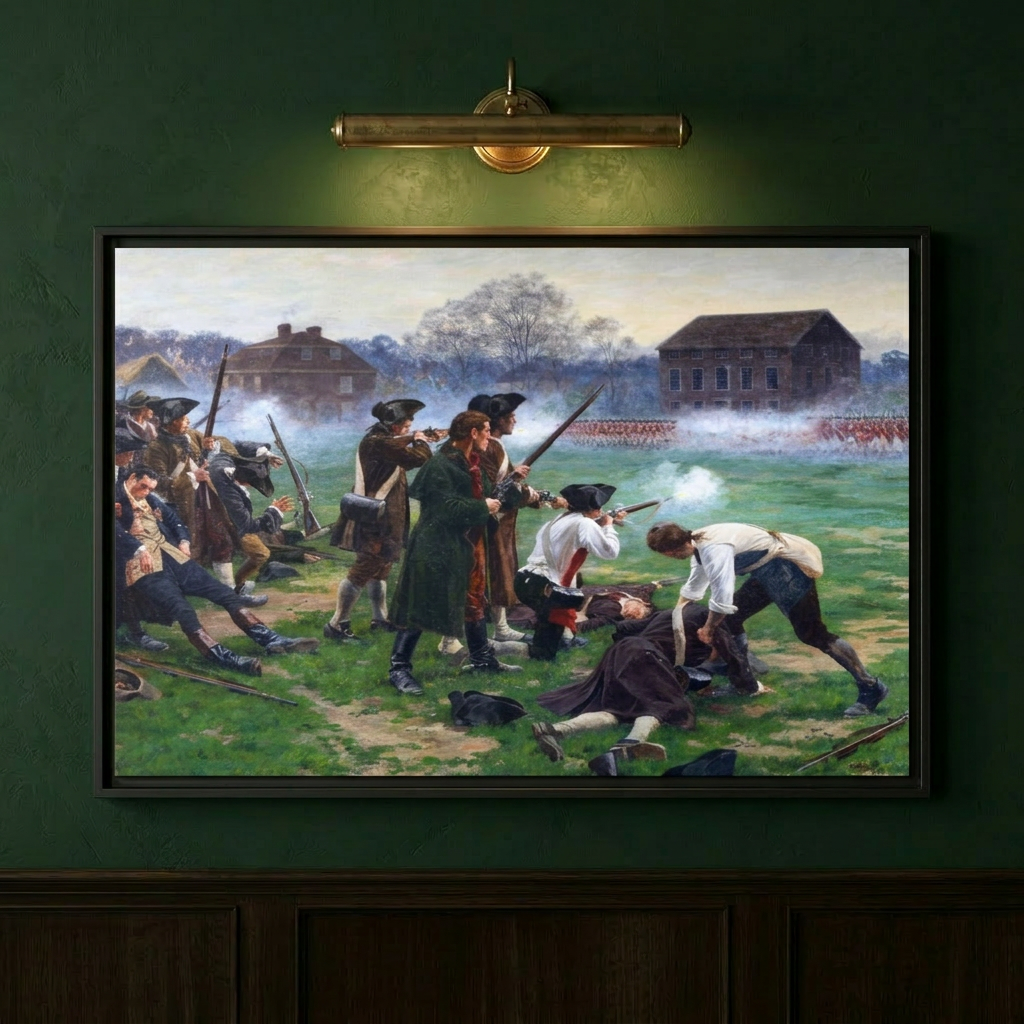
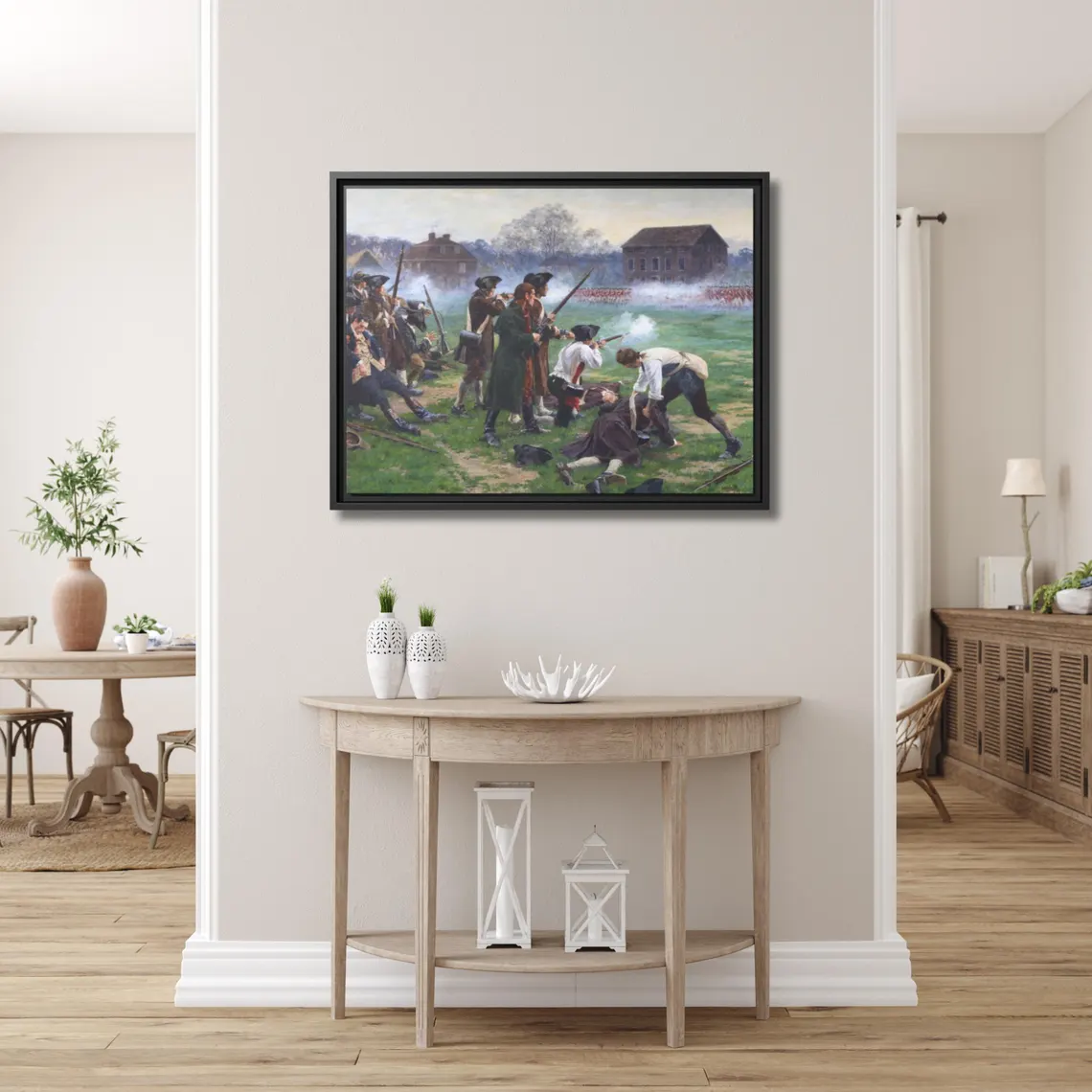
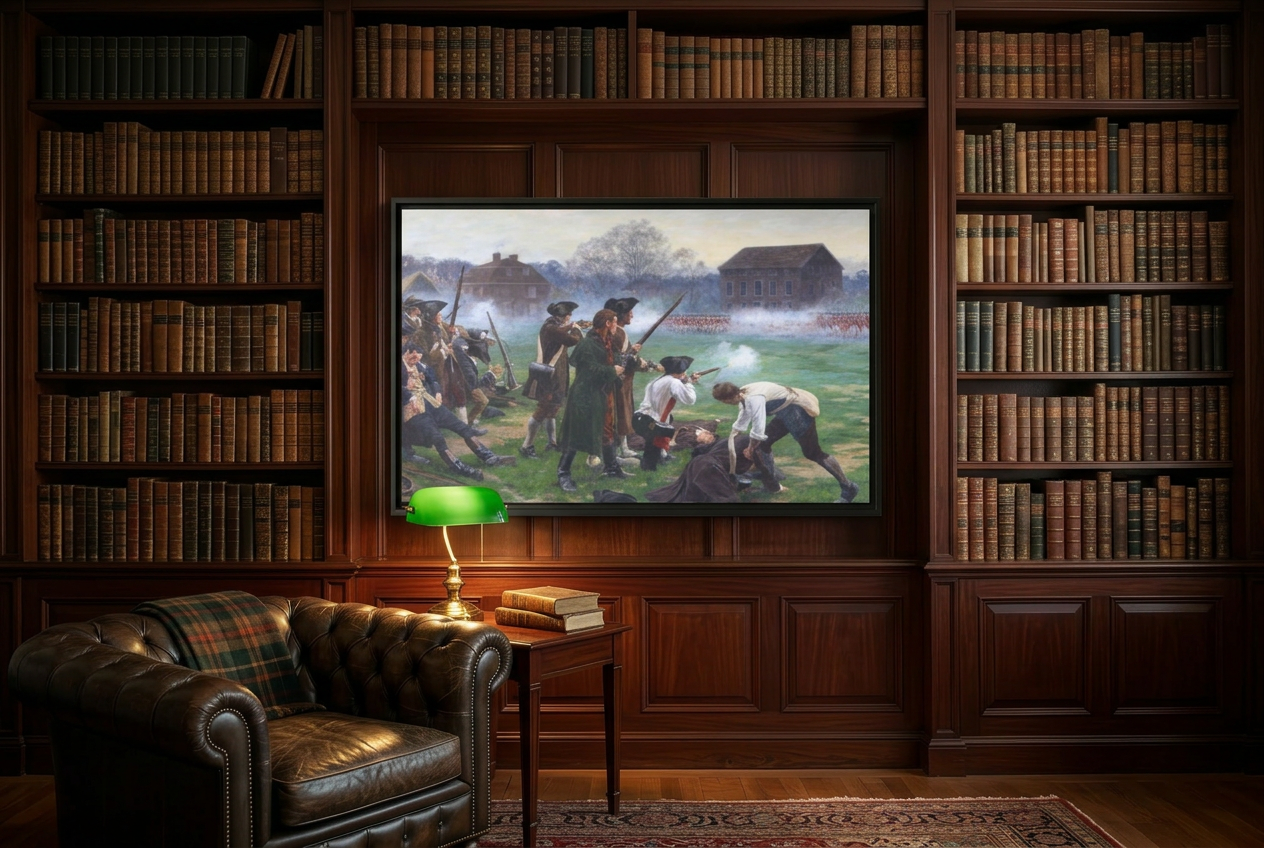
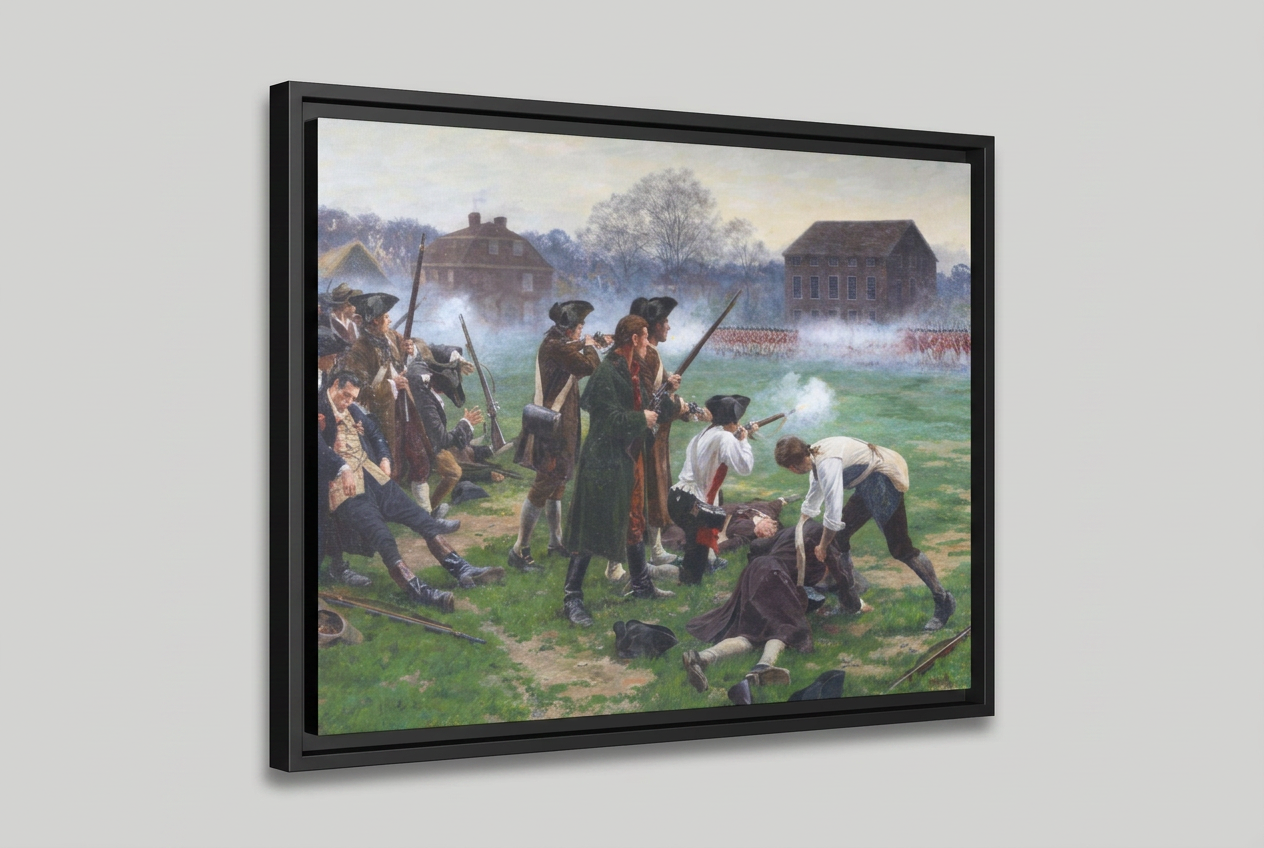


The Battle of Lexington, 19 April 1775
William Barnes Wollen (British, 1857–1936)
1910
Dawn, April 19, 1775. A small line of farmers and tradesmen stood on a village green as nearly 700 British regulars approached. No one knows who fired first. It didn't matter. By the time the smoke cleared, eight Americans lay dead, and a war that would create a nation had begun. They called it "the shot heard round the world." This is the village green where it happened.
Size
10″ x 8″ (Horizontal)
Color
Black
The Story
The Story Behind the Painting
For months, tension between the Massachusetts colonists and the British government had been building toward something neither side could fully predict.
By April 1775, British General Thomas Gage had received orders to seize colonial military supplies stored at Concord and to arrest the rebel leaders Samuel Adams and John Hancock, believed to be hiding nearby. On the night of April 18th, roughly 700 British regulars marched out of Boston under cover of darkness, hoping to reach Concord before the countryside could be alerted.
They were wrong. Paul Revere and William Dawes had already ridden ahead, warning towns along the route. By the time the British column reached Lexington at dawn on April 19th, a small company of approximately 77 colonial militiamen — farmers, tradesmen, ordinary men of the town — had assembled on the village green under the command of Captain John Parker.
What happened next has been debated by historians for two and a half centuries. Captain Parker, vastly outnumbered, reportedly ordered his men to stand their ground but not to fire unless fired upon. A shot rang out — to this day, no one knows definitively from which side — and within moments the British regulars opened fire on the small colonial line. The militia, hopelessly outmatched, scattered. Eight Americans lay dead. One British soldier was wounded.
It lasted only minutes. The British column reformed and continued on to Concord, where they would meet far stiffer resistance at the North Bridge later that morning — the engagement that forced the British to retreat all the way back to Boston under continuous fire from colonial militia gathering from every surrounding town.
But Lexington came first. It was here, on this modest village green, that the Revolutionary War began — not with a declaration, not with a formal battle plan, but with a small, confused, deadly skirmish between men who had been neighbors of the British just months before.
Ralph Earl, working with engraver Amos Doolittle, created some of the earliest visual depictions of the battle within months of the event — among the first eyewitness historical art in American history. Later artists, including the painter of this work, returned to the scene repeatedly across the following century, drawn to the raw, human cost of that April morning — the wounded being tended, the fallen mourned, the survivors still holding their muskets in stunned disbelief at what had just happened.
Ralph Waldo Emerson, writing decades later about this exact morning, called it the shot heard round the world. He was not exaggerating. Within a year, thirteen colonies would declare independence. Within eight years, a new nation would exist. It started here, on a village green, before sunrise, among men who had no idea they were making history.
Why Own It
Every revolution has a first moment. This was America's.
The Battle of Lexington belongs in the American Legacy Collection as the opening scene of the entire arc — the moment ordinary colonial life ended and the Revolutionary War began. Before Bunker Hill, before the Declaration, before Washington crossed the Delaware, there was this — a small, confused confrontation on a village green that neither side fully intended and neither side could take back.
This is a piece for the study that wants the complete story, beginning to end. The collector who understands that the Revolution did not start with grand speeches but with farmers standing their ground against impossible odds because they believed it mattered. The home that wants to remember that history's largest movements often begin in its smallest, most human moments.
Printed on premium cotton-poly canvas with archival-quality, Greenguard Gold certified inks, it is built to the same standard of permanence the subject deserves — color that endures, detail that holds, a frame crafted from sustainably sourced FSC-certified pine that will outlast the trends.
Part of the American Legacy Collection — a curated series tracing the arc of the American story from the colonial era through World War II. Own one chapter or collect them all.
Crafted for collectors. Built to be passed down.
Frequently Asked