


Join, or Die
Benjamin Franklin (American, 1706–1790)
1754
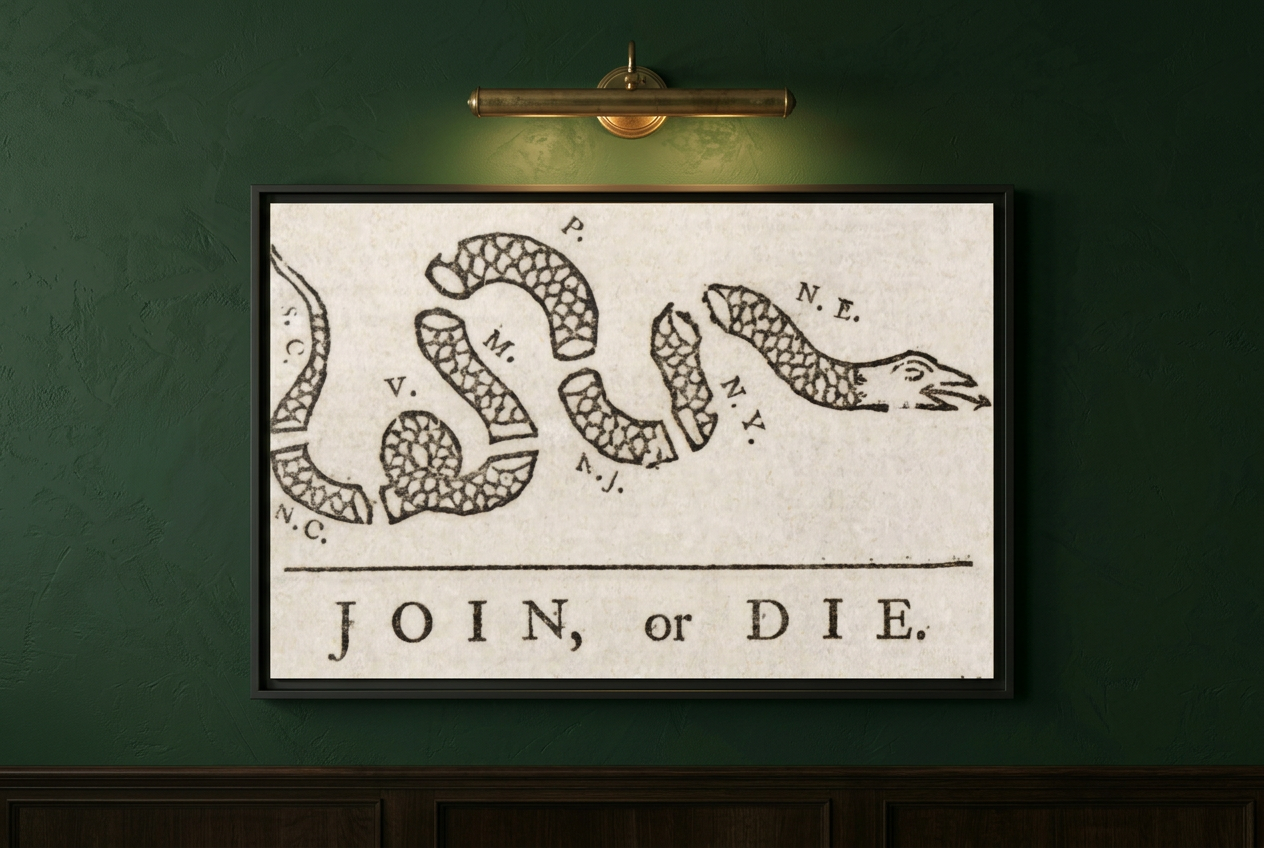
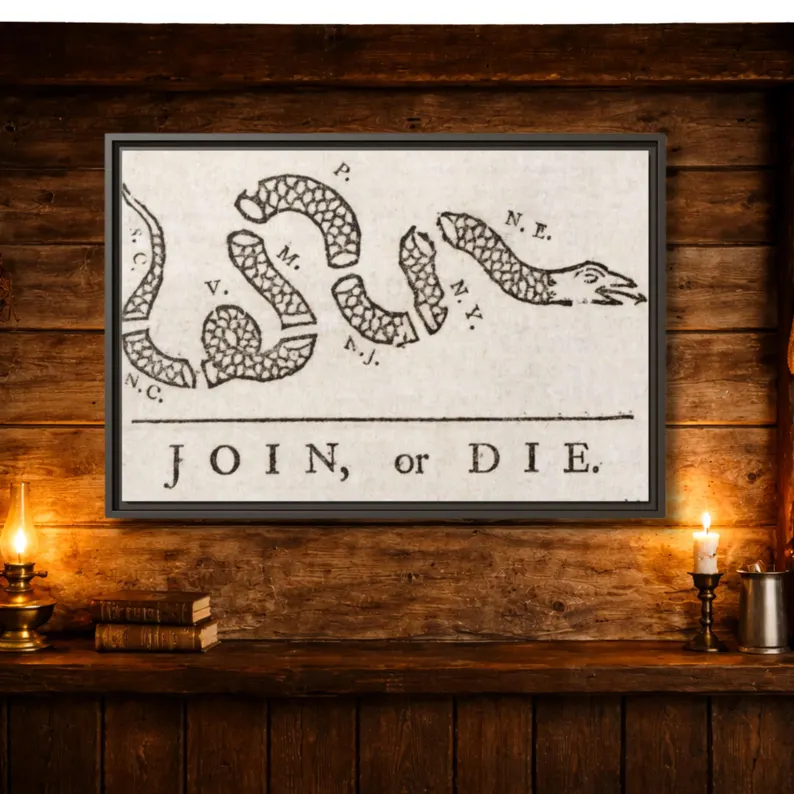
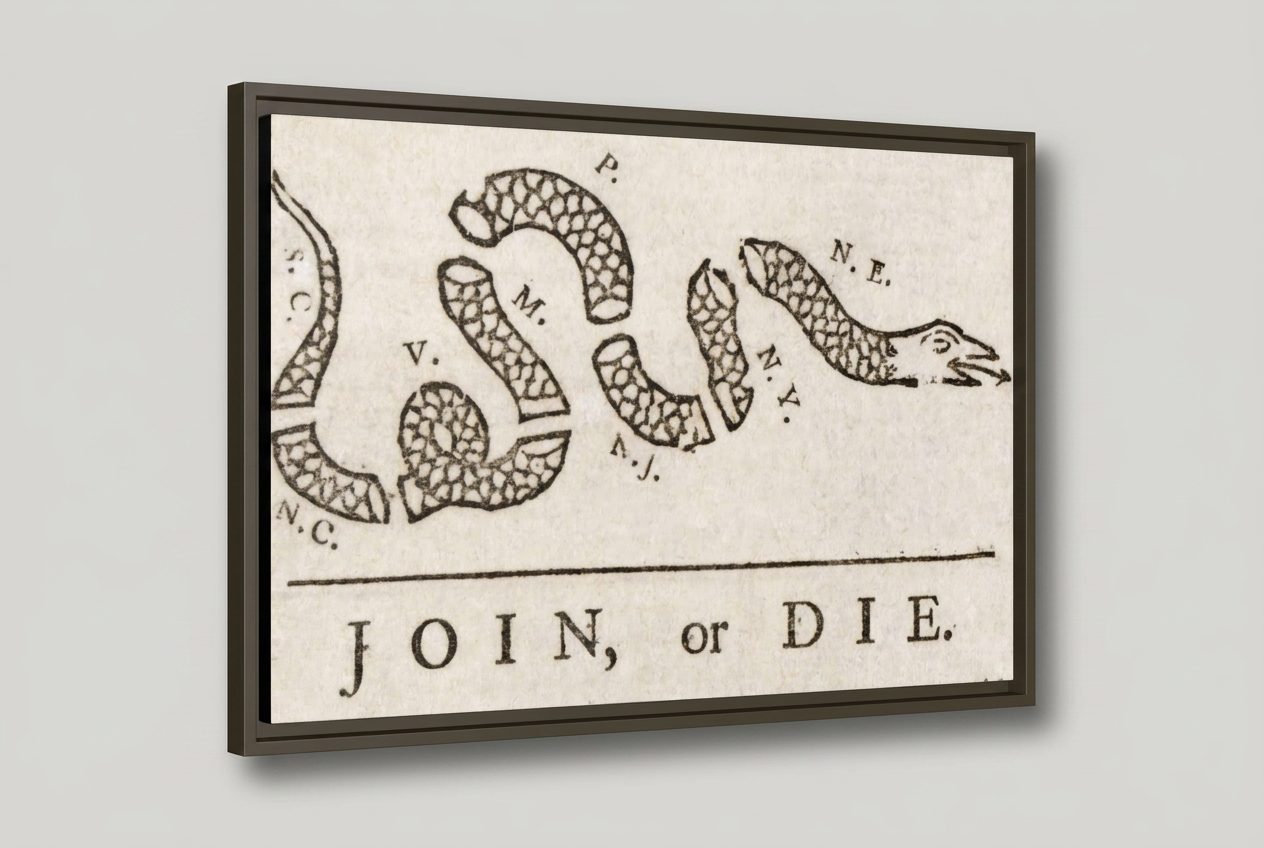
In 1754, Benjamin Franklin drew a snake cut into eight pieces and published it in his Pennsylvania Gazette. It was the first political cartoon ever printed in America. The message was three words. The meaning was everything — divided, the colonies would be destroyed. United, they could not be stopped. Twenty-two years before the Declaration of Independence, Franklin understood something no one else had yet put into words. He drew it instead.
Size
24″ x 16″ (Horizontal)
Color
Espresso
The Story
The Story Behind This Piece
Benjamin Franklin was many things — printer, scientist, diplomat, Founding Father. But in 1754, he was primarily a newspaper publisher with a political problem he needed the public to understand quickly.
The problem was the French and Indian War, which was beginning to unfold along the colonial frontier. The British colonies in America were fractured, competing, and deeply reluctant to cooperate with each other — each colony more focused on its own affairs than on the collective threat bearing down from the north and west. Franklin had attended the Albany Congress, a gathering of colonial representatives meant to address exactly this problem, and had come away convinced that the colonies' survival depended on unity they showed no sign of achieving.
On May 9, 1754, he published in his Pennsylvania Gazette what would become the most reproduced image in colonial American history — a woodcut of a snake severed into eight segments, each labeled with the initials of a colony or colonial region. Beneath it, three words: JOIN, or DIE.
The image drew on a popular superstition of the era — the belief that a snake cut in pieces could be revived if the parts were rejoined before sunset. Franklin inverted the metaphor deliberately: the colonies, like the snake, could only survive if they came back together. Divided, they were already dead.
The cartoon was reprinted immediately across colonial newspapers — an act of viral distribution that Benjamin Franklin himself, as a printer and postmaster, was uniquely positioned to facilitate. It reappeared during the Stamp Act crisis of 1765, republished by colonial newspapers as a symbol of resistance to British taxation. It appeared again in 1774 and 1775 as revolutionary sentiment hardened, the snake now reassembled and defiant rather than cut apart and dying.
By the time the Revolution began in earnest, Franklin's image had been in colonial consciousness for twenty years. It had migrated from a plea for cooperation against a French threat to something larger — a symbol of the colonies' collective identity and their shared stake in what happened next.
It is the first American political cartoon. It is also, arguably, the first American political statement — the moment a colonial printer looked at thirteen fractious communities and said, in the simplest possible language: you are already one thing. Act like it.
Why Own It
Three words. One image. The beginning of American unity.
Join, or Die belongs in the American Legacy Collection as its earliest piece — predating the Revolution by more than two decades, predating the Declaration by twenty-two years, predating even the first stirrings of organized colonial resistance. Franklin drew this in 1754, when the idea of American independence was not yet a thought in anyone's mind. He was not calling for revolution. He was calling for survival. And in doing so, he planted the seed of something that would take another generation to flower.
This is a piece for the collector who wants the complete arc — not just the Declaration and the battles, but the moment before any of it was possible, when one man with a printing press understood that unity was not just a political strategy but a matter of life and death. The study or library that honors the power of a single image to change the way people think. The home that wants to remember that America's story did not begin in 1776 — it began much earlier, in the minds of people who could see what was coming before anyone else.
Printed on premium cotton-poly canvas with archival-quality, Greenguard Gold certified inks, it is built to the same standard of permanence the subject deserves — color that endures, detail that holds, a frame crafted from sustainably sourced FSC-certified pine that will outlast the trends.
Part of the American Legacy Collection — a curated series tracing the arc of the American story from the colonial era through World War II. Own one chapter or collect them all.
Crafted for collectors. Built to be passed down.
Frequently Asked