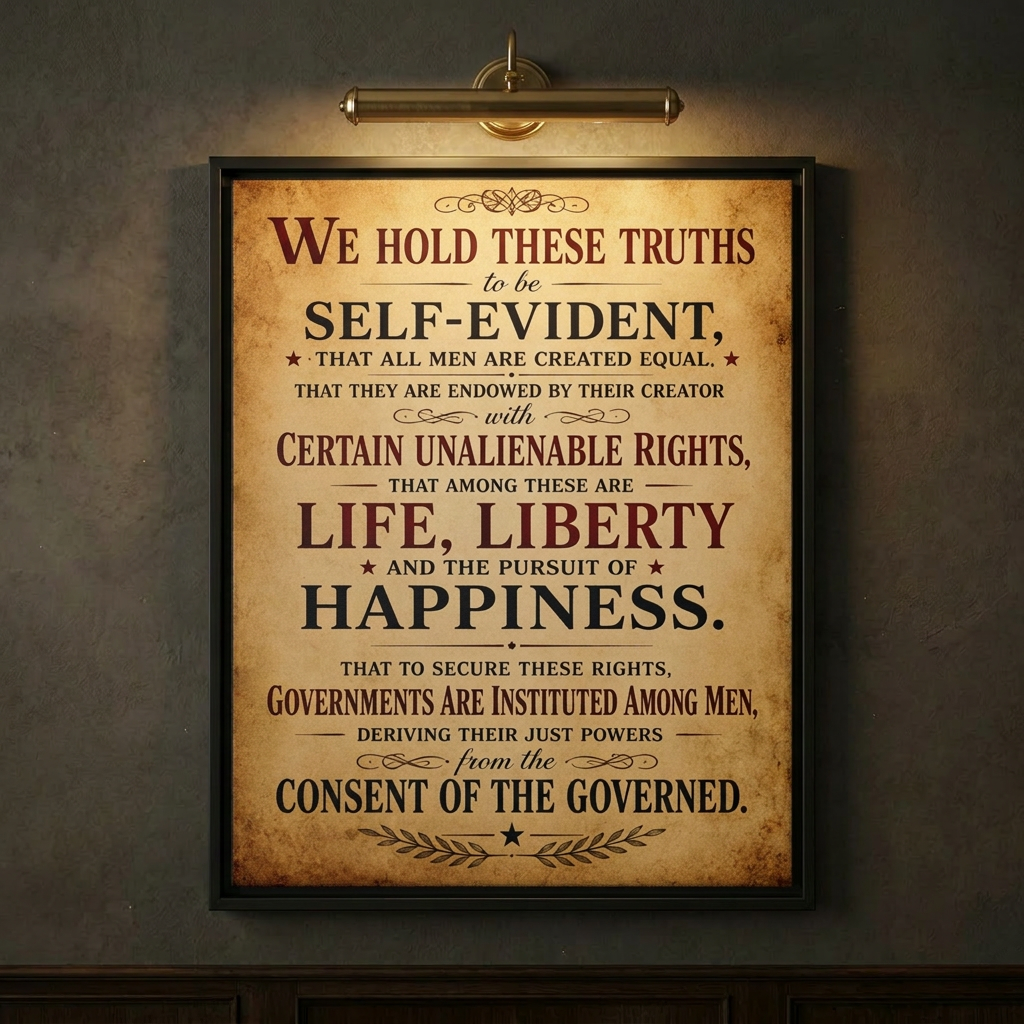
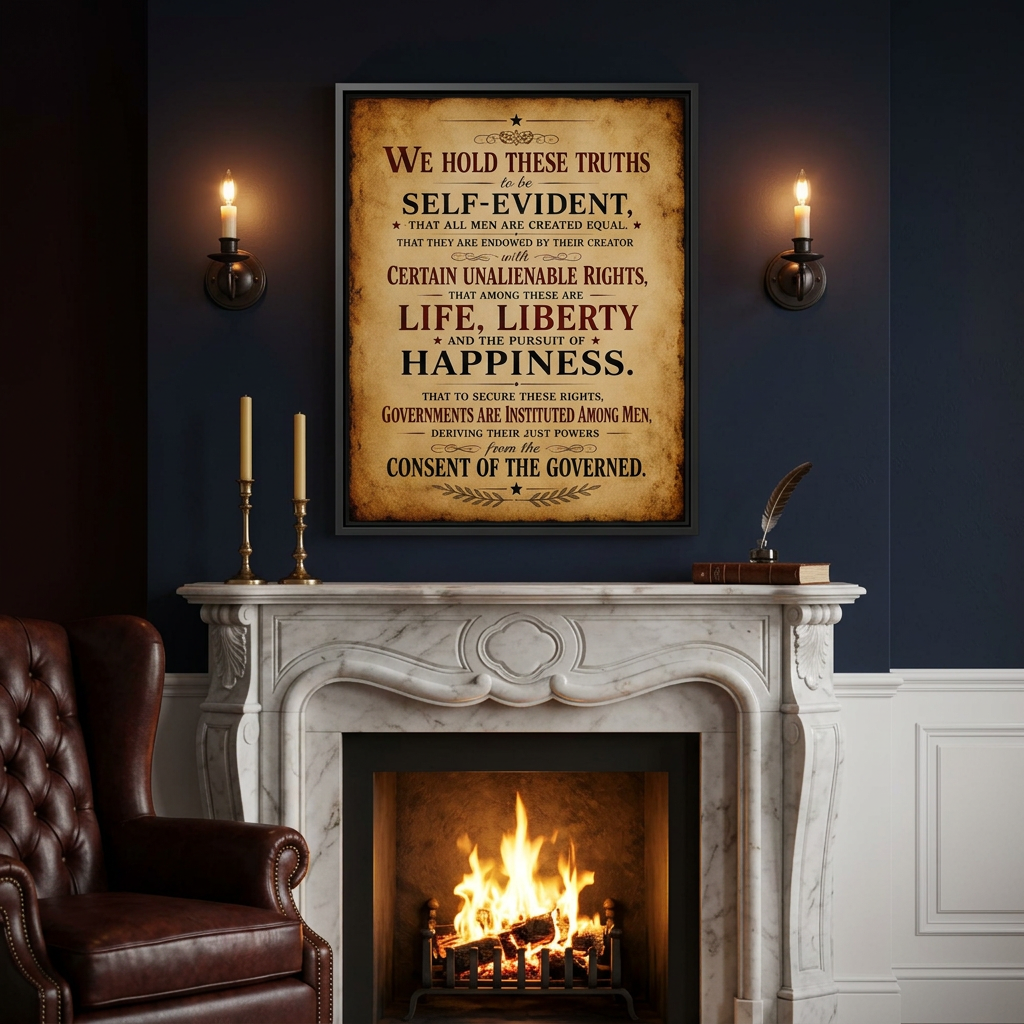

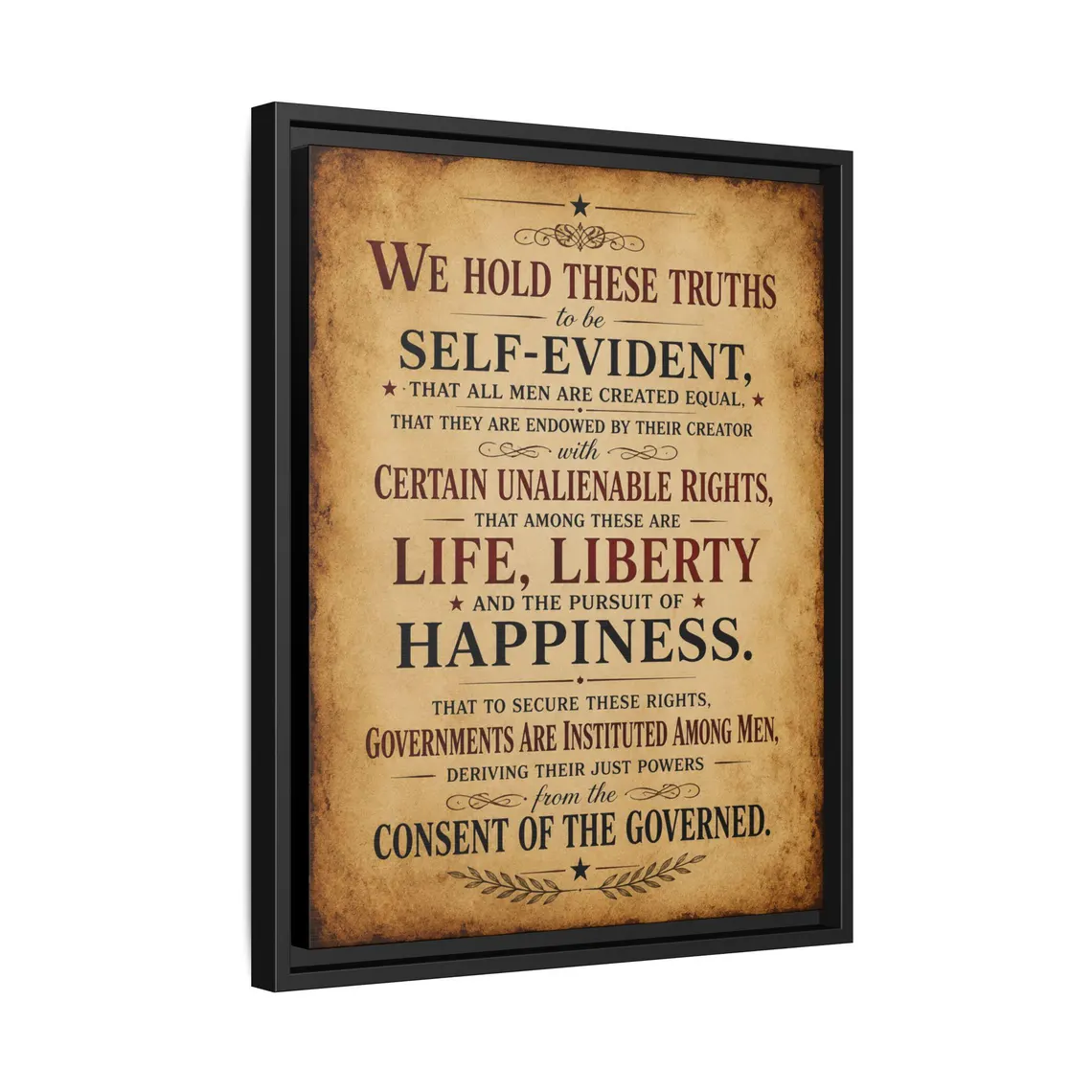


Preamble to the Declaration of Independence
Drafted by Thomas Jefferson (American, 1743–1826), with the Committee of Five
1776
In the summer of 1776, a 33-year-old Virginia lawyer sat alone in a rented room in Philadelphia and wrote the sentence that changed the world. Not a battle plan. Not a treaty. Fifty-six words that redefined what government was for, what rights were inalienable, and what kind of nation America intended to be. Two hundred and fifty years later those words have never been improved upon. They have only been lived up to — imperfectly, stubbornly, and without surrender.
Size
8″ x 10″ (Vertical)
Color
Black
The Story
The Story Behind This Piece
No one asked Thomas Jefferson to write something immortal.
The Continental Congress simply needed a document. A formal declaration explaining to the world — and to King George III — why the American colonies were separating from Britain. It was a political necessity, not an invitation to philosophy. John Adams later recalled that Jefferson was chosen for the task partly because he was a Virginian, partly because he was known as a gifted writer, and partly because Adams himself didn't want to do it.
Jefferson had seventeen days.
He worked alone in a second-floor room he had rented from a Philadelphia bricklayer named Jacob Graff. No library. No research materials beyond what he carried in his head. He wrote and rewrote, crossing out words and replacing them, searching for the exact formulation that would say what needed to be said with the precision the moment demanded.
Congress was not gentle with his draft. Over two days they edited, debated, and cut approximately a quarter of Jefferson's original text. Jefferson sat in silence watching them work, reportedly pained by every deletion. Adams, seated beside him, quietly reassured him. What survived was leaner than what Jefferson had written — and more powerful for it.
Every word in the final version was chosen with surgical precision. "Self-evident" — not argued, not debated, simply true. "Unalienable" — impossible to transfer, surrender, or have taken away. "Pursuit of happiness" — a phrase Jefferson chose deliberately over the more conventional "property," reaching toward something more expansive, more human, and more permanent.
The Declaration was adopted on July 4, 1776. It was read aloud in public squares across the colonies to crowds who had never heard anything like it. John Adams wrote to his wife Abigail that the occasion ought to be celebrated with "pomp and parade, bonfires and illuminations" every year for generations to come.
He was right. It has been. And the words that started it all have never stopped being true.
Why Own It
These are not famous words. They are the words everything else is built on.
We Hold These Truths belongs in the American Legacy Collection as its philosophical foundation — the statement of purpose that preceded every battle, every sacrifice, and every hard-won advance in the American story. This piece was designed for the reader who wants the words themselves, bold and unambiguous, impossible to scan past without stopping.
This is a piece for the office where decisions are made in the knowledge that they rest on something solid. The study where the founding principles are not footnotes but foundations. The home that wants every person who walks through the door to be reminded what this country decided to be at its beginning.
Printed on premium cotton-poly canvas with archival-quality, Greenguard Gold certified inks, it is built to the same standard of permanence the subject deserves — color that endures, detail that holds, a frame crafted from sustainably sourced FSC-certified pine that will outlast the trends.
Part of the American Legacy Collection — a curated series tracing the arc of the American story from the colonial era through World War II. Own one chapter or collect them all.
Crafted for collectors. Built to be passed down.
Frequently Asked