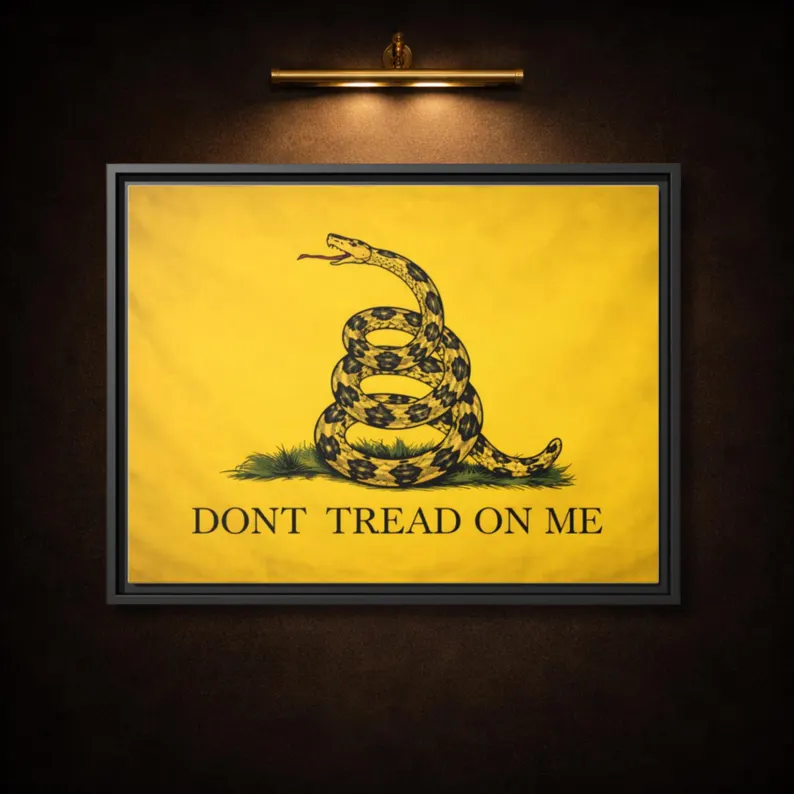


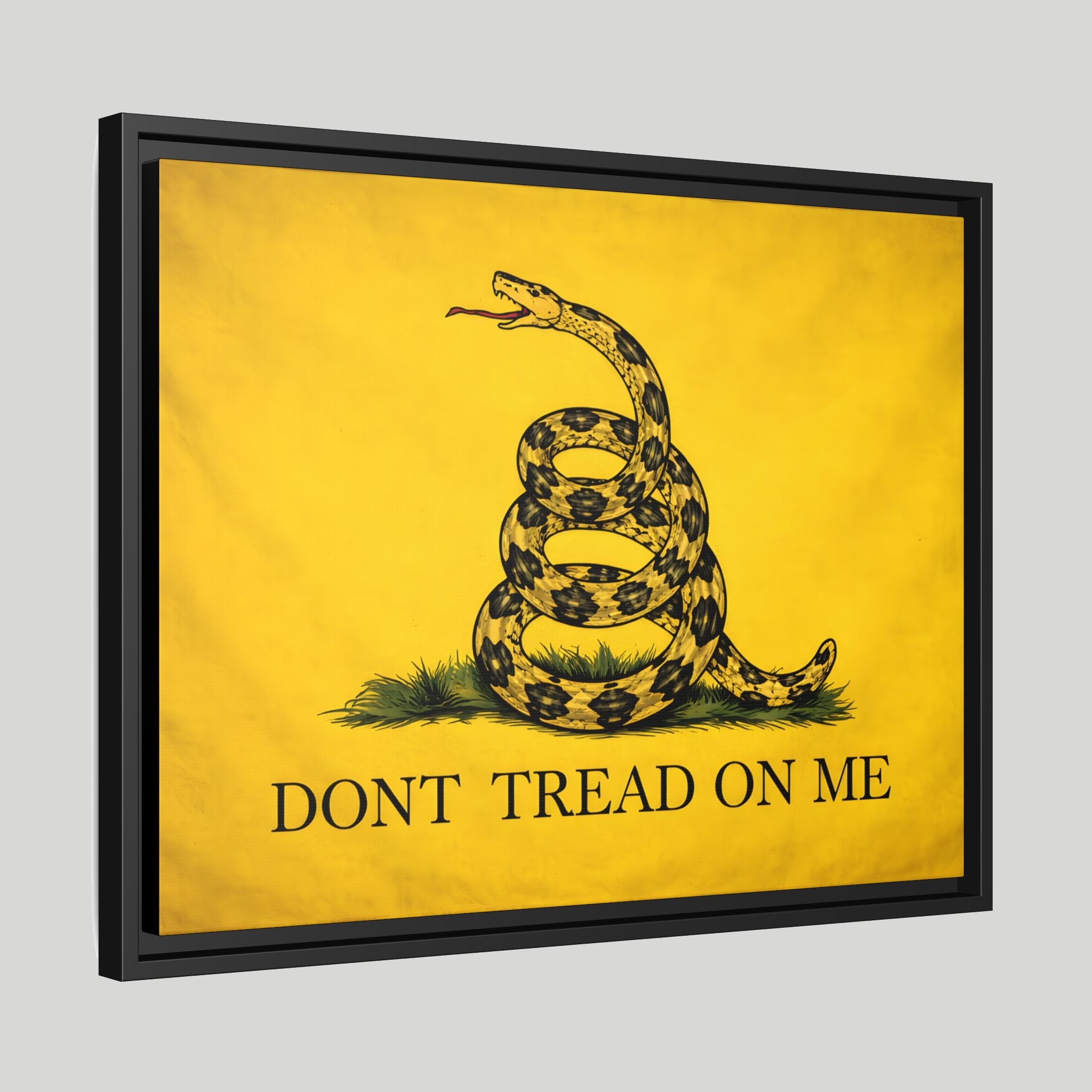


The Gadsden Flag
Christopher Gadsden (American, 1724–1805)
1775
In 1775, Christopher Gadsden walked into the Continental Congress carrying a yellow flag with a coiled rattlesnake and four words. He had designed it himself as a personal standard for Commodore Esek Hopkins, commander of the first American naval fleet. The rattlesnake had been Benjamin Franklin's choice of symbol for America since 1751 — native to the continent, impossible to surprise, and once provoked, never backs down. Two hundred and fifty years later the flag is still flying. The message has not changed.
Size
18″ x 12″ (Horizontal)
Color
Espresso
The Story
The Story Behind This Piece
Benjamin Franklin made the case for the rattlesnake as America's symbol in 1751, long before anyone was talking seriously about independence.
In a satirical essay published in his Pennsylvania Gazette, Franklin proposed sending rattlesnakes to England in exchange for the convicts Britain kept shipping to the colonies. He was being darkly funny — but the rattlesnake imagery stuck, and he returned to it repeatedly in the years that followed. The snake, Franklin argued, was a uniquely American creature. It did not attack unprovoked. It gave warning before it struck. It never surrendered. And the individual rattles, separate but part of a single animal, were a natural metaphor for colonies that needed to act together or die apart — the same idea he had expressed in Join, or Die a year earlier.
By 1775, with the Revolutionary War beginning, the rattlesnake had become a widely recognized symbol of colonial resistance. It appeared on currency, on drums, on military flags carried by Continental Army regiments. The message it carried — self-reliance, warning, and the absolute certainty of retaliation if provoked — resonated with colonists who had spent years trying peaceful resistance and were done trying.
Christopher Gadsden was a South Carolina delegate to the Continental Congress and one of the most forceful voices for independence in the early days of the Revolution. In early 1776, he presented Congress with a flag he had designed — bright yellow, a coiled timber rattlesnake in the center, and below it four words: DONT TREAD ON ME.
Gadsden intended it as the personal standard of Commodore Esek Hopkins, newly appointed commander of the Continental Navy's first fleet. Hopkins flew it from his ship. The Continental Marines carried a similar rattlesnake design on their drums. The flag entered American military and political culture immediately and has never fully left it.
In the centuries since, the Gadsden Flag has been adopted and re-adopted by successive movements — libertarian, military, patriotic — each finding in its simple imagery a statement of principled self-determination that transcends any single political moment. Its origins, however, are unambiguous: it was born in 1775 as a symbol of a people who had decided they were done being governed without their consent, and who were prepared to defend that position.
The rattlesnake is still coiled. The warning is still there.
Why Own It
Four words. Two hundred and fifty years. Still coiled.
The Gadsden Flag belongs in the American Legacy Collection as one of the founding era's most enduring visual statements — a symbol designed in 1775 that has proven more durable than most of the institutions created in the same period. Its message is not complicated. It does not require explanation. It states a position clearly, gives fair warning, and trusts the viewer to understand what comes next.
This is a piece for the study or office that believes in self-reliance, principled resistance, and the American tradition of telling power exactly where the line is. The home that wants the founding era's most direct statement of individual sovereignty displayed with the historical weight it has always carried. The collector who understands that this flag was not designed as a political statement in the modern sense — it was designed as a declaration of character, and that is what it remains.
Printed on premium cotton-poly canvas with archival-quality, Greenguard Gold certified inks, it is built to the same standard of permanence the subject deserves — color that endures, detail that holds, a frame crafted from sustainably sourced FSC-certified pine that will outlast the trends.
Part of the American Legacy Collection — a curated series tracing the arc of the American story from the colonial era through World War II. Own one chapter or collect them all.
Crafted for collectors. Built to be passed down.
Frequently Asked