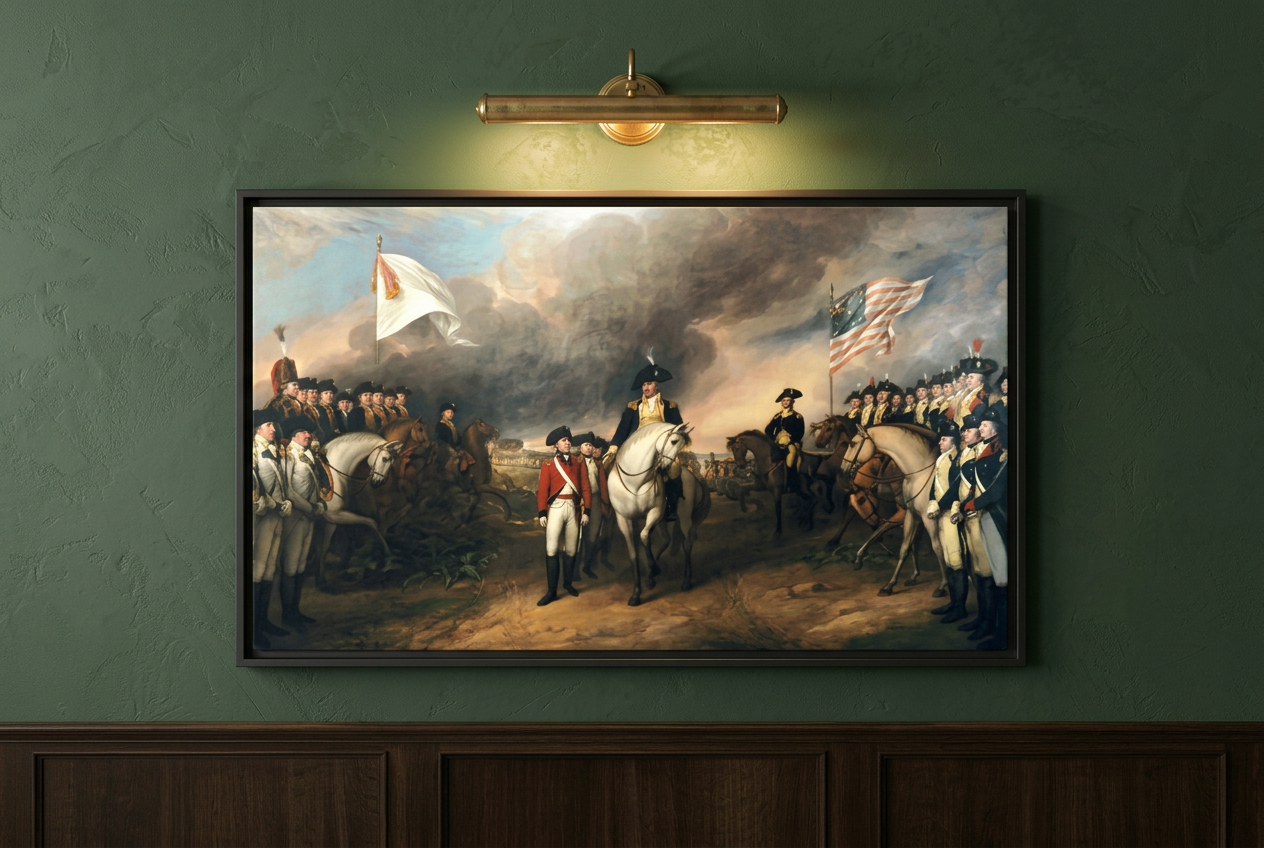
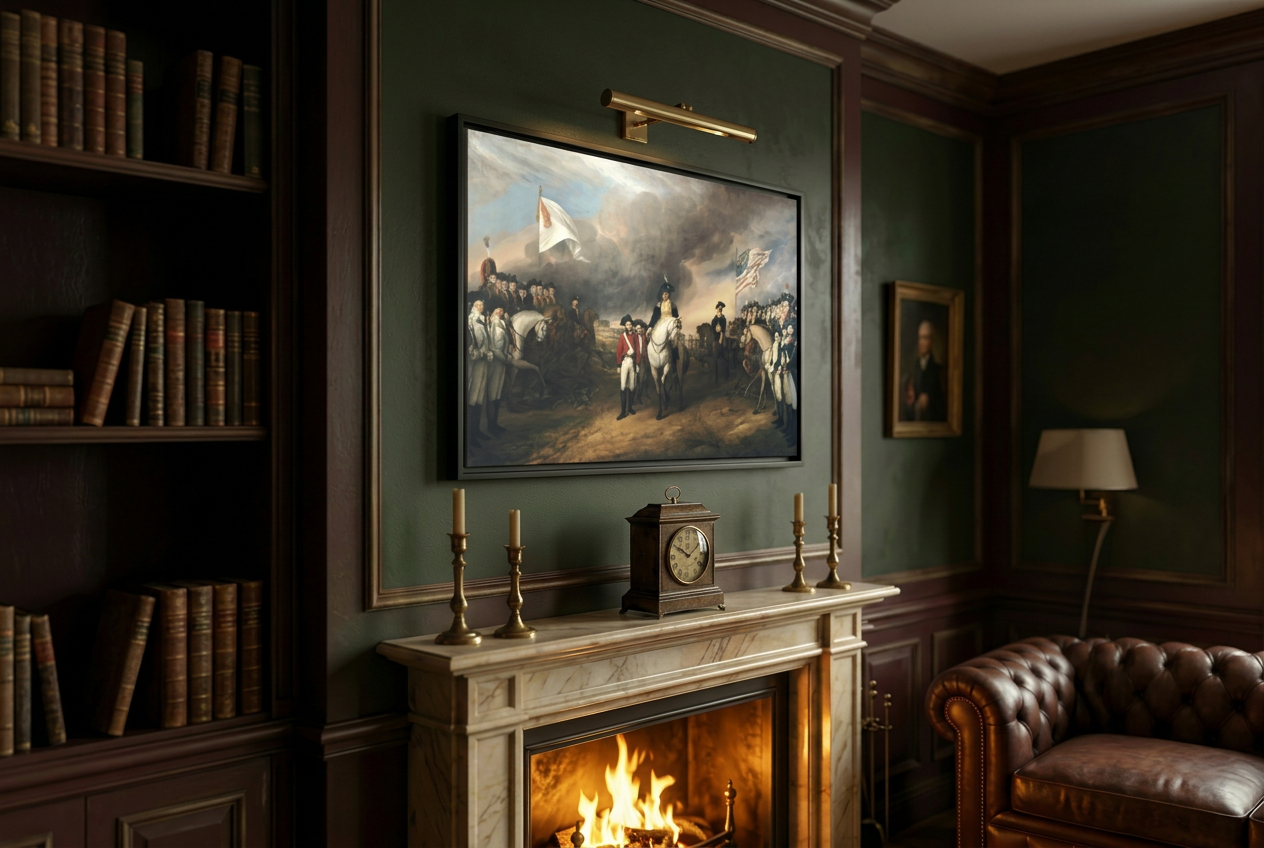
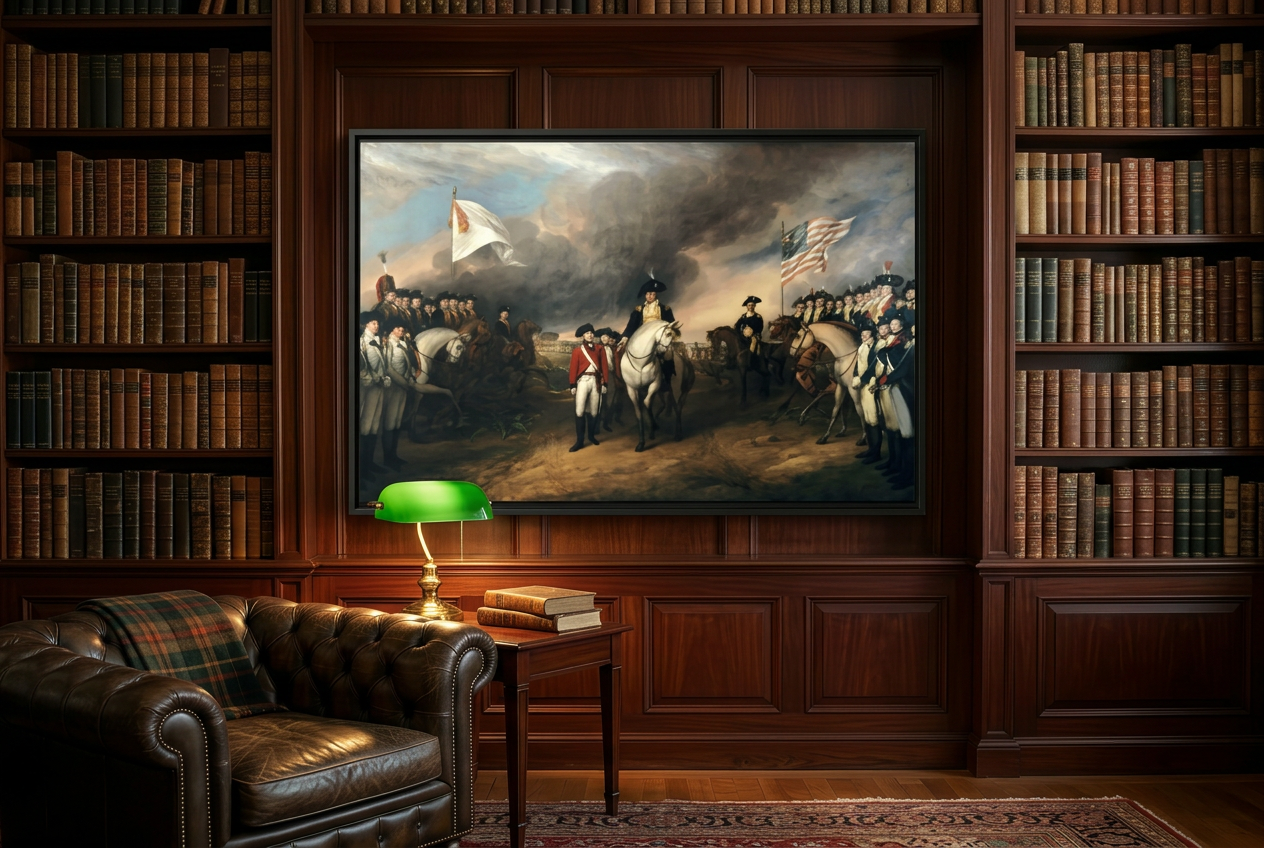
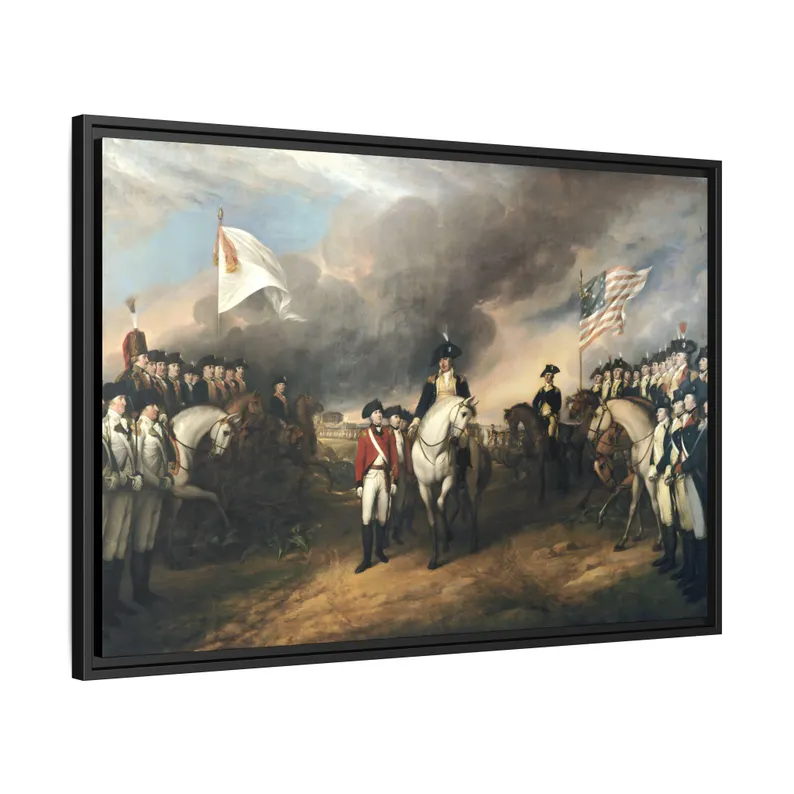

Surrender of Lord Cornwallis at Yorktown, October 19, 1781
John Trumbull (American, 1756–1843)
1820
October 19, 1781. Lord Cornwallis — too proud to face Washington in defeat — sent his deputy to surrender in his place. Washington, recognizing the slight, refused to accept the sword himself and directed the deputy to his own second-in-command. The Revolution was over. And in his final act, Washington demonstrated exactly the character that had won it. John Trumbull was there to make sure history never forgot.
Size
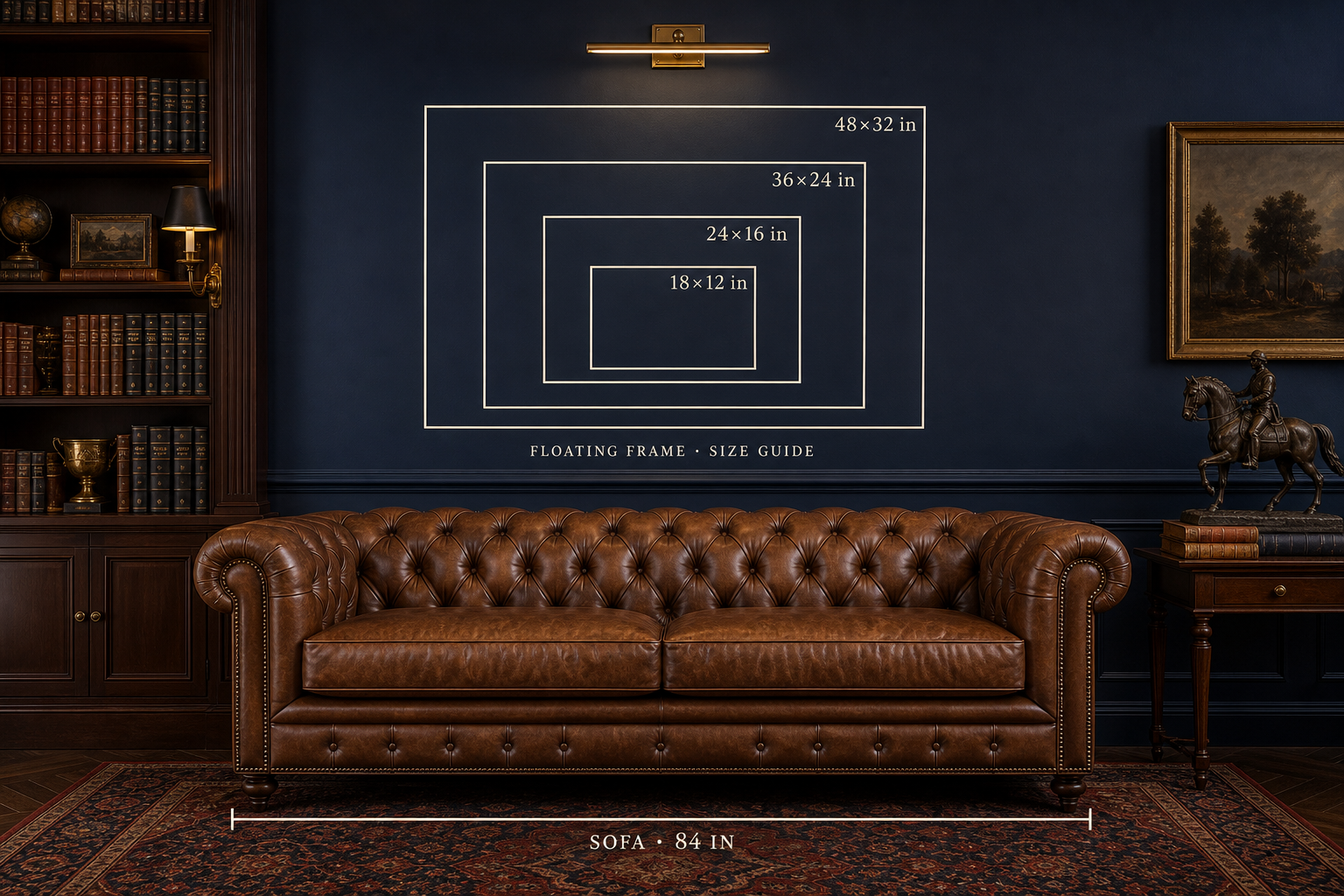
18″ x 12″ (Horizontal)
Color
Black
The Story
The Story Behind the Painting
Eight years. That is how long it took.
Eight years of frozen winters and desperate retreats. Of Valley Forge and Trenton and Yorktown. Of an army that was perpetually outnumbered, undersupplied, and on the verge of dissolution. Eight years of George Washington holding together a revolution through sheer force of character when every military calculation said it was finished.
On October 19, 1781, it was finally over.
The British Army at Yorktown — nearly 8,000 men under Lord Cornwallis — marched out to surrender to the combined American and French forces that had laid siege to their position for three weeks. It was the last major campaign of the American Revolution. The war that had begun with farmers facing redcoats at Lexington and Concord ended here, on a Virginia field, with the most powerful army in the world laying down its arms.
Cornwallis did not come.
Citing illness — an excuse no one believed — he sent his second-in-command, General Charles O'Hara, to deliver the surrender. It was a calculated insult. O'Hara attempted first to present the sword to French General Rochambeau, who declined and directed him to Washington. Washington, understanding the slight immediately and with characteristic dignity, refused to accept the sword from a deputy — and directed O'Hara to his own second-in-command, General Benjamin Lincoln.
Protocol was satisfied. Honor was preserved. And Washington had answered arrogance with something far more powerful — grace.
John Trumbull painted this scene with a meticulous devotion to historical accuracy that borders on the obsessive. Every face in the painting is a portrait painted from life. The French officers — including Rochambeau and Lafayette — were painted personally by Trumbull in Thomas Jefferson's house in Paris, where Jefferson was serving as American minister to France. Washington, Lincoln, and the American officers were painted from life in the United States. Trumbull spent years assembling the faces, traveling between continents to get them right.
The result hangs today in the Rotunda of the United States Capitol — one of four Revolutionary War masterpieces Trumbull painted for that singular space. It is among the most historically documented paintings in American history. Every man in that frame was real. Every face was earned.
Why Own It
This is where it ended. And where everything else began.
The Surrender of Cornwallis belongs in the American Legacy Collection as the closing chapter of the Revolution — the moment eight years of sacrifice resolved into something permanent. Washington crossing the Delaware was the turning point. This was the destination. Together they tell the complete story of how a nation that should not have survived became one that could not be stopped.
What makes this piece extraordinary is not just what it depicts but how it was made. Trumbull did not paint a symbol or an allegory. He painted the actual men — their actual faces, recorded from life, preserved for every generation that followed. To own this painting is to look at the men who were standing on that field on October 19, 1781. Not representations. Not composites. Them.
This is a piece for the study that understands history is not abstract. The office that draws its sense of possibility from those who created it against impossible odds. The home that wants its walls to remember what was won, what it cost, and who paid it.
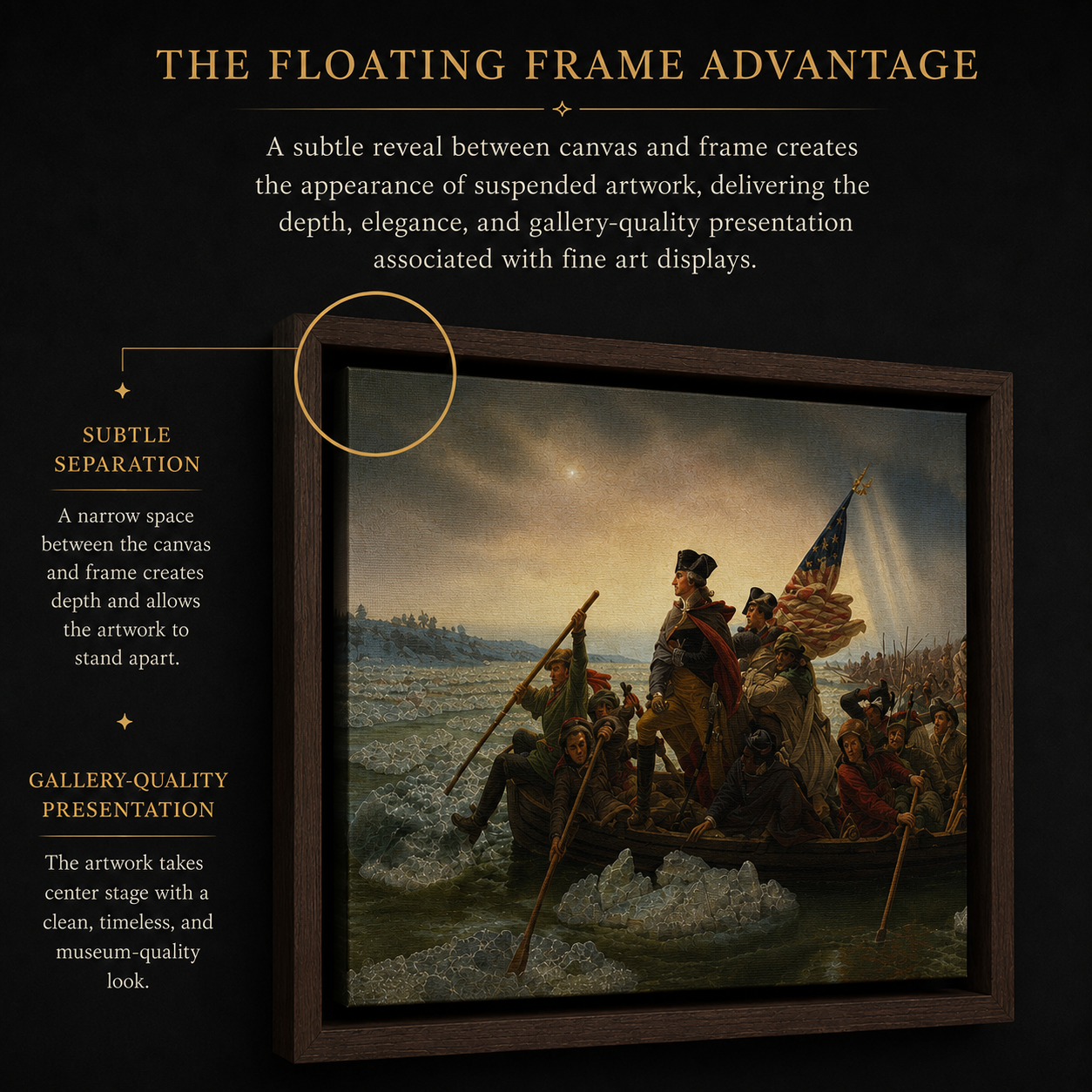
Printed on premium cotton-poly canvas with archival-quality, Greenguard Gold certified inks, it is built to the same standard of permanence the subject deserves — color that endures, detail that holds, a frame crafted from sustainably sourced FSC-certified pine that will outlast the trends.
Part of the American Legacy Collection — a curated series tracing the arc of the American story from the colonial era through World War II. Own one chapter or collect them all.
Crafted for collectors. Built to be passed down.
Frequently Asked