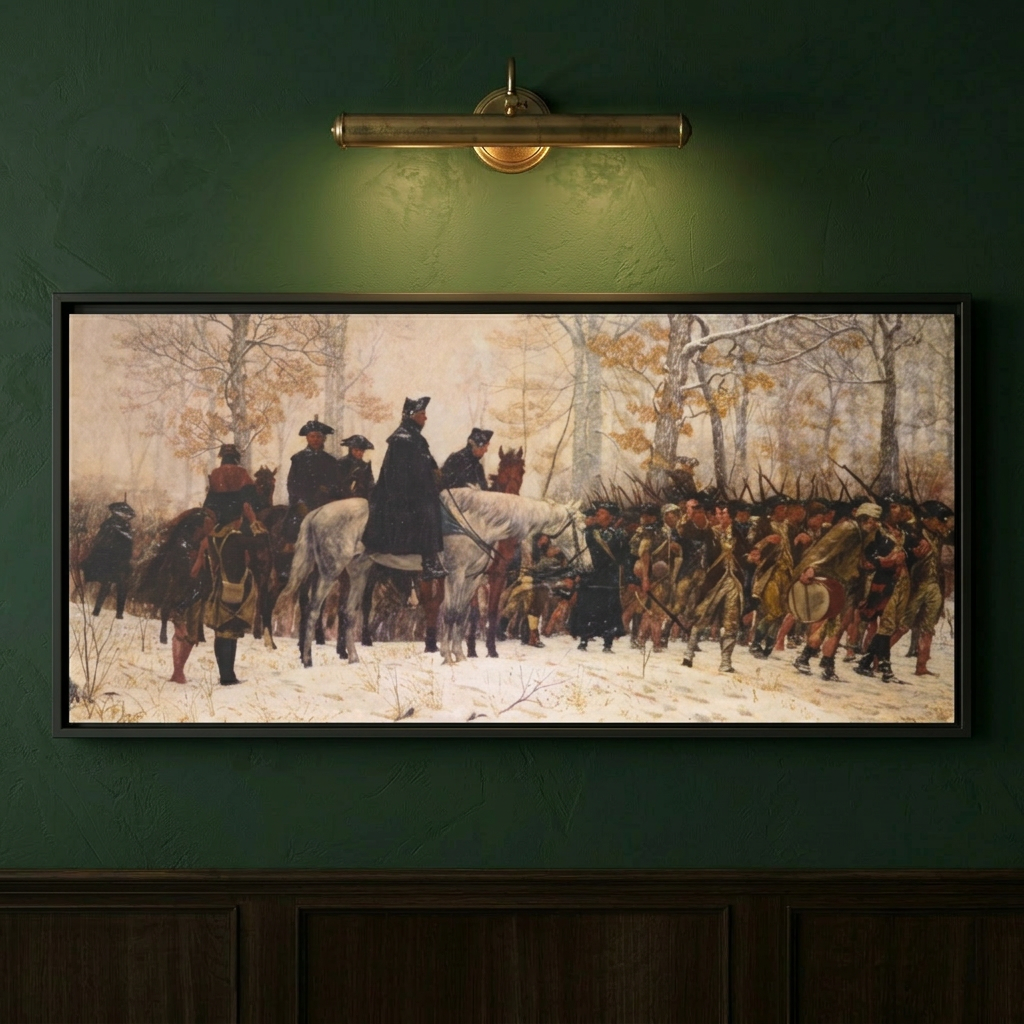
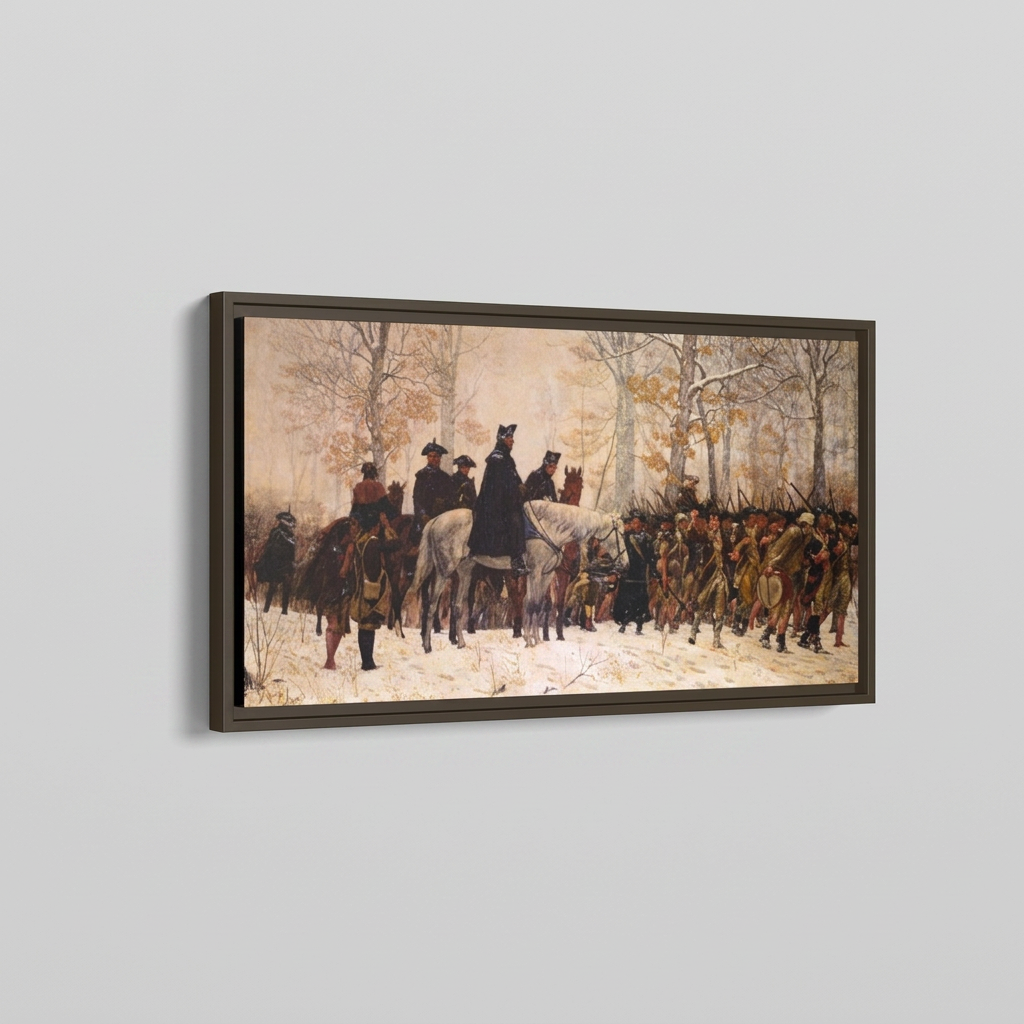



The March to Valley Forge, December 19, 1777
William B. T. Trego (American, 1859–1909)
1883
The winter of 1777. No boots. No blankets. No food. Two thousand men dead — not in battle, but from cold, starvation, and disease. And yet when spring came, the army that marched out of Valley Forge was something the army that marched in had never been — disciplined, hardened, and unbreakable. Washington did not win at Valley Forge. He survived it. That turned out to be enough.
Size
20" x 10" (Horizontal)
Color
Black
The Story
The Story Behind the Painting
Valley Forge was not a battle. That is what most people miss.
No shots were fired there. No enemy was engaged. The Continental Army marched into that Pennsylvania winter on December 19, 1777 — after a bruising autumn campaign that had seen Philadelphia fall to the British — and simply tried to survive. For six months, in brutal cold that dropped well below freezing, in makeshift huts with inadequate clothing, dwindling rations, and rampant disease, approximately 12,000 men held together through nothing but will and the example of their commander.
Nearly 2,000 of them did not make it to spring.
Washington chose Valley Forge deliberately — a position high enough to defend, close enough to Philadelphia to threaten British operations, far enough away to prevent his exhausted army from dissolving into the civilian population. It was a military calculation made under impossible conditions. But what happened there went far beyond military strategy.
The army that arrived at Valley Forge was a collection of state militias — undisciplined, poorly trained, and accustomed to fighting in the loose colonial style that had served them intermittently but never decisively. The army that left was something different entirely.
That transformation had a name: Friedrich Wilhelm August Heinrich Ferdinand von Steuben.
The Prussian drillmaster arrived at Valley Forge in February 1778 and immediately set about doing what no one had managed to do in two years of war — teaching the Continental Army to fight like professionals. He drilled them in the snow. He cursed at them in German and French when his English failed him — and then laughed at himself, which made the men love him. He wrote a training manual that became the standard for the American military for decades. By the time the army marched out of Valley Forge in June 1778, it could execute battlefield maneuvers that had previously been beyond it entirely.
Washington watched all of it and understood what it meant.
He had kept the army alive through the winter through presence alone — riding through the camp daily, visible to his men, sharing their conditions rather than sheltering from them. Men who had every reason to desert, to despair, and to quit looked at Washington on his horse in the snow and found a reason to stay. That was not strategy. That was character.
The painting captures the march — Washington mounted, his officers around him, the long column of soldiers moving through bare winter trees with their muskets shouldered and their resolve intact. It is not a dramatic battle scene. It is something quieter and more powerful — an army deciding, together, that it will not be broken.
Why Own It
Some victories happen on battlefields. This one happened in the mind.
Washington at Valley Forge belongs in the American Legacy Collection because Valley Forge is where the Revolution was truly won — not with a military triumph but with a refusal to accept defeat when defeat was the reasonable response. The British were warm and well-fed in Philadelphia. The Continental Army was freezing in the woods. And when spring came, only one of those armies was ready to fight.
That is an American story. It is the American story — the one that recurs across every chapter of the arc, from the desperate crossing of the Delaware to the frozen forests of the Ardennes two centuries later. The willingness to endure what others will not, to stay when others leave, to emerge from the worst conditions stronger than you entered them.
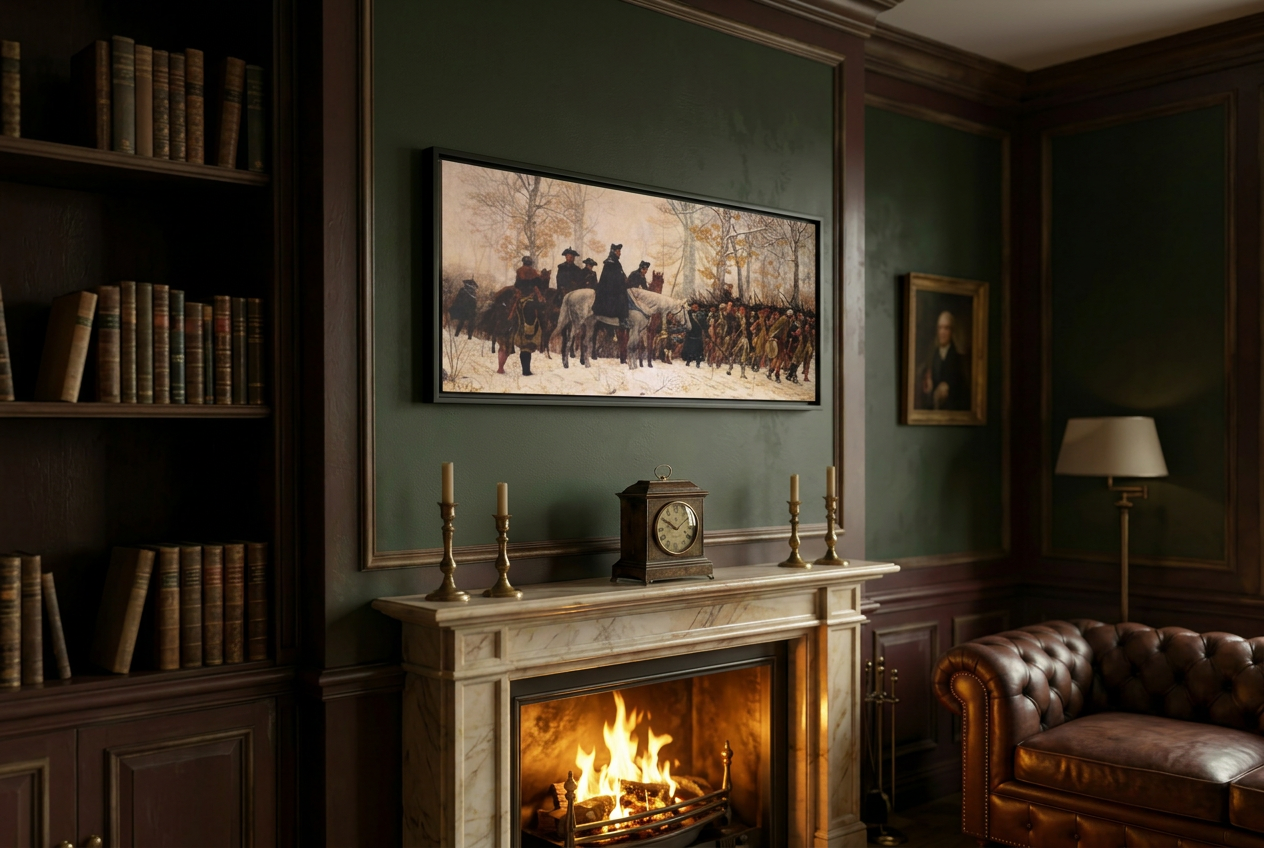
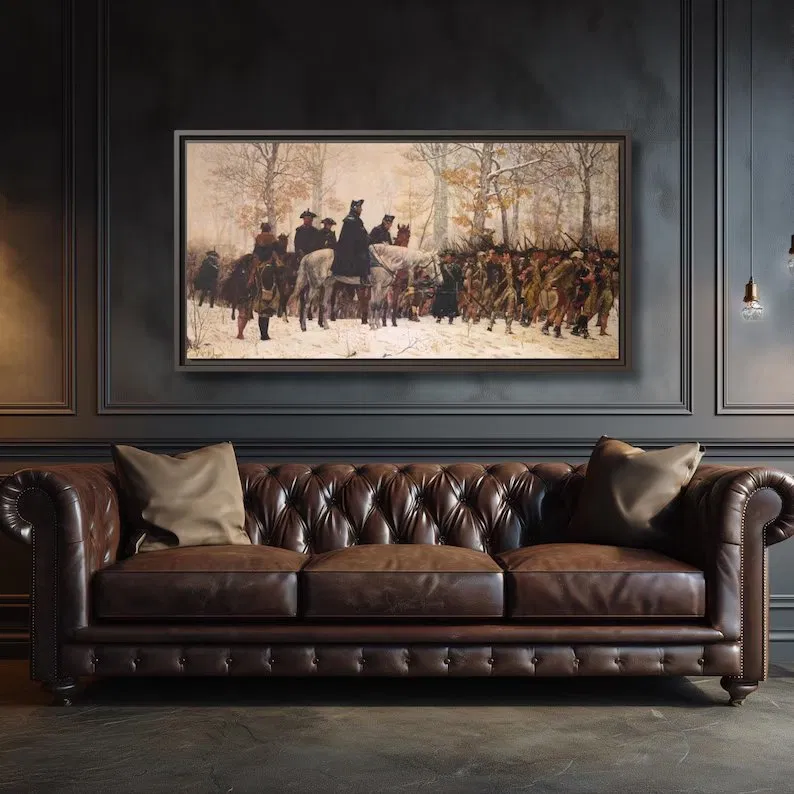
This panoramic piece commands a room the way the subject commands history — quietly, completely, and without apology. The wide horizontal format and the muted winter palette make it as much an atmospheric work as a historical one — at home in a study, a library, a living room, or any space that values depth over decoration.
Printed on premium cotton-poly canvas with archival-quality, Greenguard Gold certified inks, it is built to the same standard of permanence the subject deserves — color that endures, detail that holds, a frame crafted from sustainably sourced FSC-certified pine that will outlast the trends.
Part of the American Legacy Collection — a curated series tracing the arc of the American story from the colonial era through World War II. Own one chapter or collect them all.
Crafted for collectors. Built to be passed down.
Frequently Asked