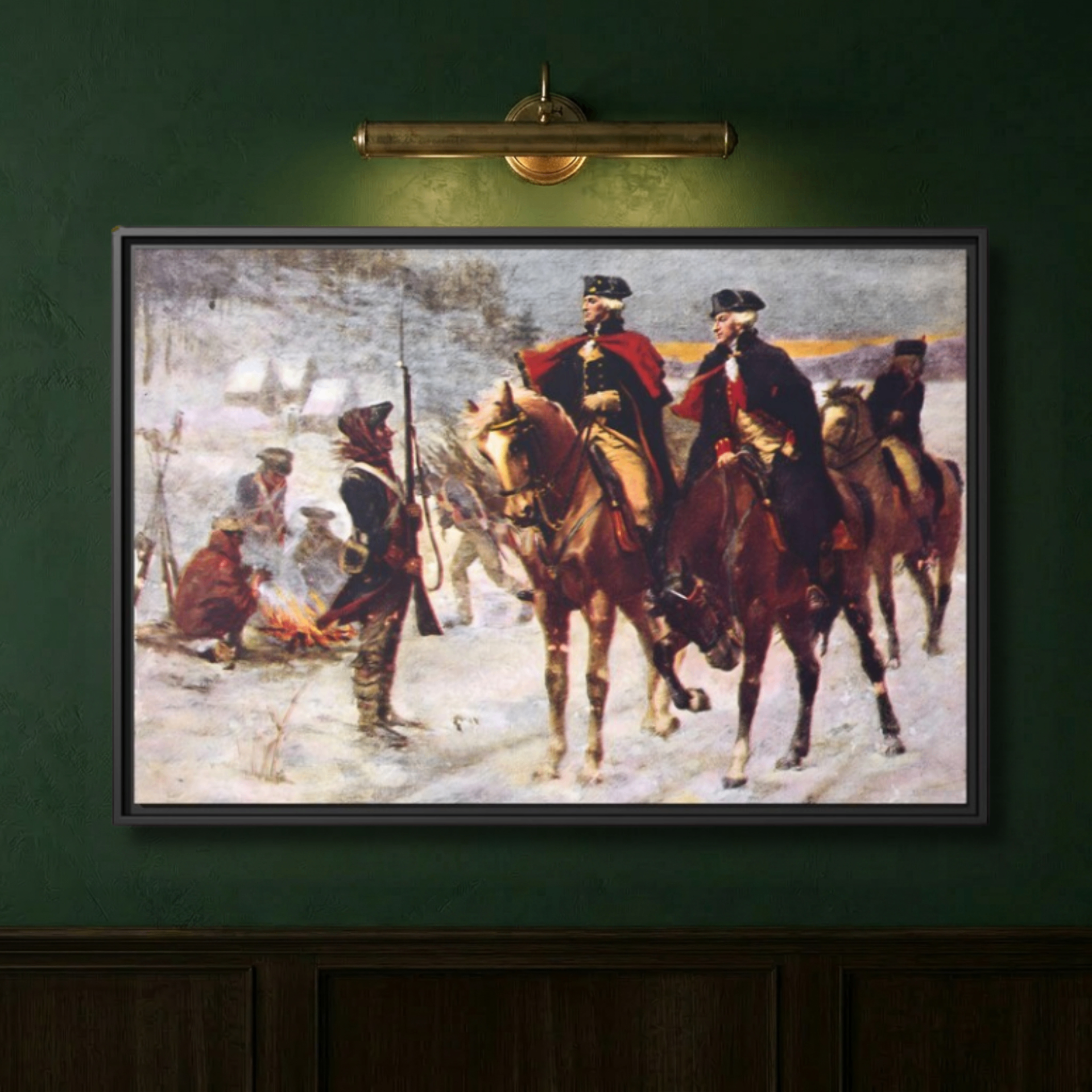
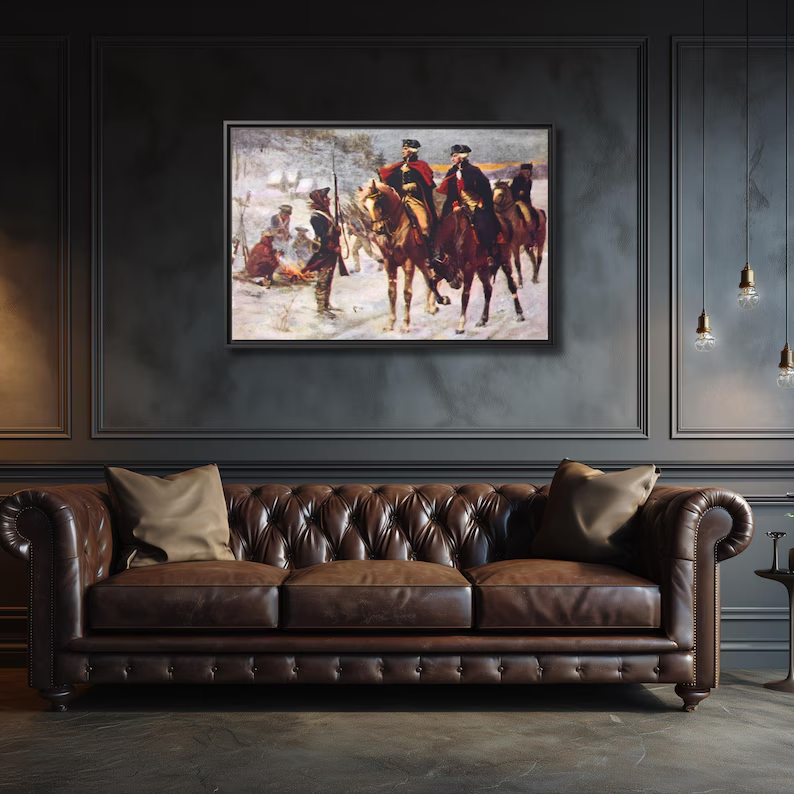
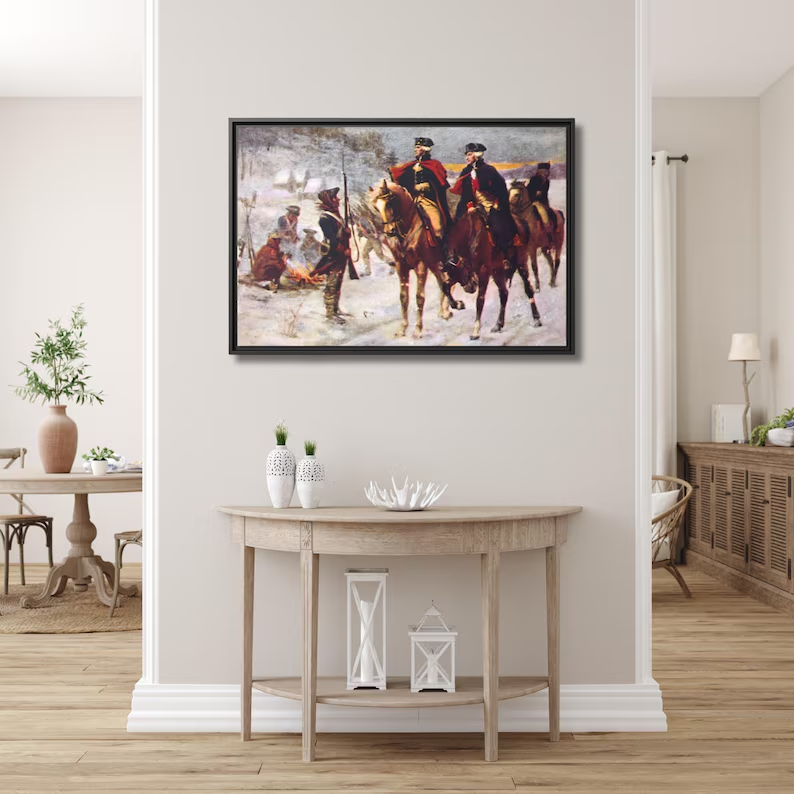
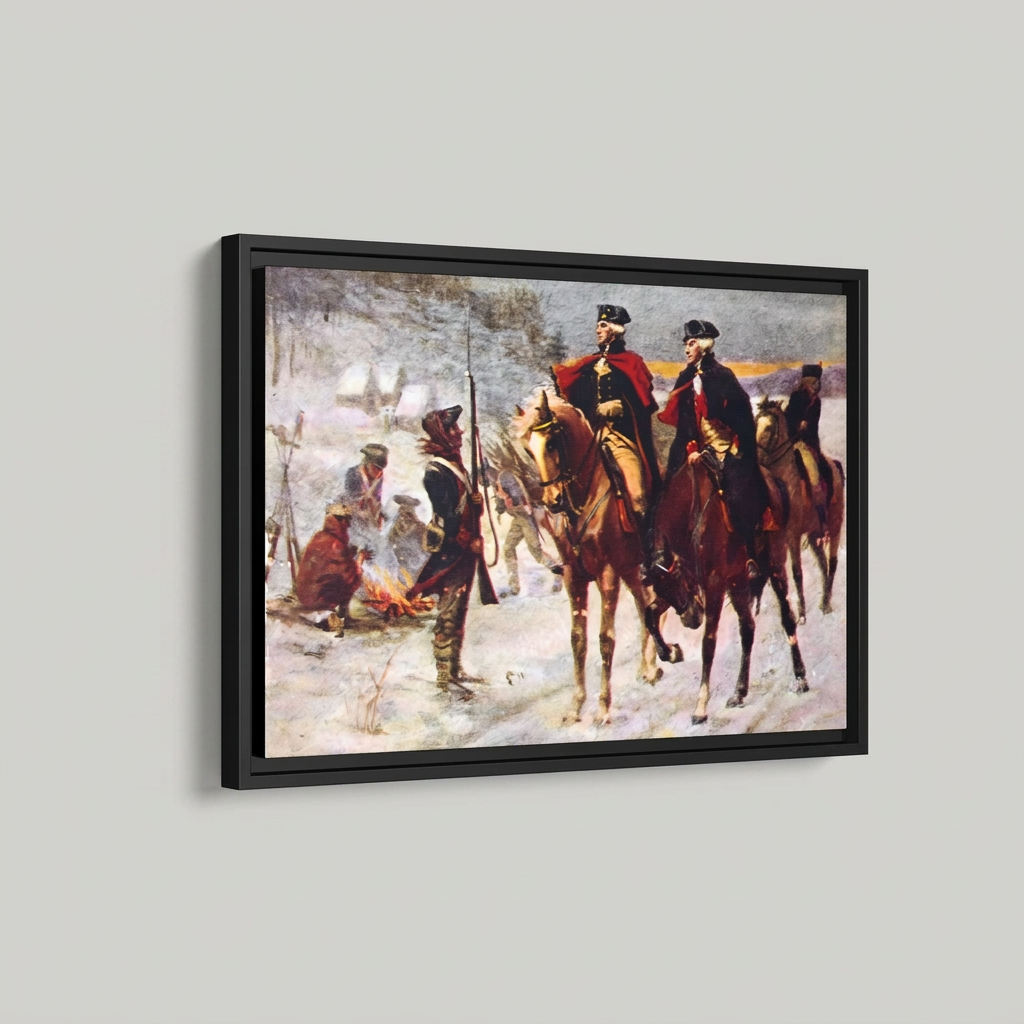


Washington and Lafayette at Valley Forge
Edwin Austin Abbey (American, 1852–1911)
1910
Two men on horseback ride through the snow at Valley Forge. One is the Commander-in-Chief of the Continental Army. The other is a nineteen-year-old French nobleman who had crossed the Atlantic at his own expense, without his government's permission, because he believed in a revolution he had only read about. At the fire in the foreground, soldiers who have no boots warm themselves as best they can. These are the men Washington and Lafayette were asking to hold on just a little longer. Somehow, they did.
Size
24″ x 16″ (Horizontal)
Color
Espresso
The Story
The Story Behind the Painting
The friendship between George Washington and the Marquis de Lafayette is one of the most remarkable relationships in American history — and one of the most unlikely.
Marie-Joseph Paul Yves Roch Gilbert du Motier de Lafayette was nineteen years old when he arrived in America in June 1777, having defied the French king's explicit orders not to go. He was enormously wealthy, well-connected, and had no particular military experience beyond what he had learned in a French cavalry regiment. He also had no obligation whatsoever to involve himself in someone else's revolution on another continent.
He came anyway. He paid for his own ship. He offered to serve without pay. He told Congress he wanted to learn, not to command.
Washington, who had been burned repeatedly by foreign officers who arrived with inflated credentials and immediately demanded authority they hadn't earned, was initially skeptical. Within months he had changed his mind entirely. Lafayette was wounded at the Battle of Brandywine in September 1777 — his first major engagement — and refused to leave the field until Washington ordered him to. He arrived at Valley Forge that winter and stayed through everything.
What developed between the two men over the following years was something Washington's officers quietly noticed and remarked upon — a relationship that resembled, in the ways that mattered, that of father and son. Washington had no biological children. Lafayette had lost his own father before his second birthday, killed in battle during the Seven Years' War. The two men found in each other something neither had elsewhere.
Abbey's painting captures them together at Valley Forge in the winter of 1777-78 — the bleakest period of the war, when the Continental Army's survival was genuinely uncertain. Washington rides in his red-lined cape, Lafayette beside him in the darker coat of a Continental officer, both surveying the encampment they are asking their men to endure. In the foreground, soldiers cluster around a small fire — the inadequate warmth of men who have almost nothing left but stubbornness and belief.
Lafayette wrote to his wife from Valley Forge that the misery and poverty of the camp were beyond description. He then spent his own personal fortune on supplies for the men under his command, purchasing clothing and food with his own money because there was no other way to get it.
He was nineteen years old.
Why Own It
The American Revolution was not won by Americans alone.
Washington and Lafayette at Valley Forge belongs in the American Legacy Collection as a reminder that the founding of this nation was an international act — that a French teenager crossed an ocean because he believed the American experiment mattered to the world, not just to the thirteen colonies fighting it. Lafayette's presence at Valley Forge, his willingness to stay through the worst of it, his personal investment — literally, financially — in the survival of the Continental Army was part of what made survival possible.
The two figures on horseback in this painting represent something larger than their individual biographies — the idea that the cause of liberty has never belonged exclusively to any single nation, and that people will cross oceans for it when they believe it is real.
This is a piece for the study that honors the alliances that made American independence possible. The home that understands the Revolution as a world-historical event, not just an American one. The collector who wants the complete story — including the nineteen-year-old Frenchman who showed up uninvited and became one of its essential figures.
Printed on premium cotton-poly canvas with archival-quality, Greenguard Gold certified inks, it is built to the same standard of permanence the subject deserves — color that endures, detail that holds, a frame crafted from sustainably sourced FSC-certified pine that will outlast the trends.
Part of the American Legacy Collection — a curated series tracing the arc of the American story from the colonial era through World War II. Own one chapter or collect them all.
Crafted for collectors. Built to be passed down.
Frequently Asked