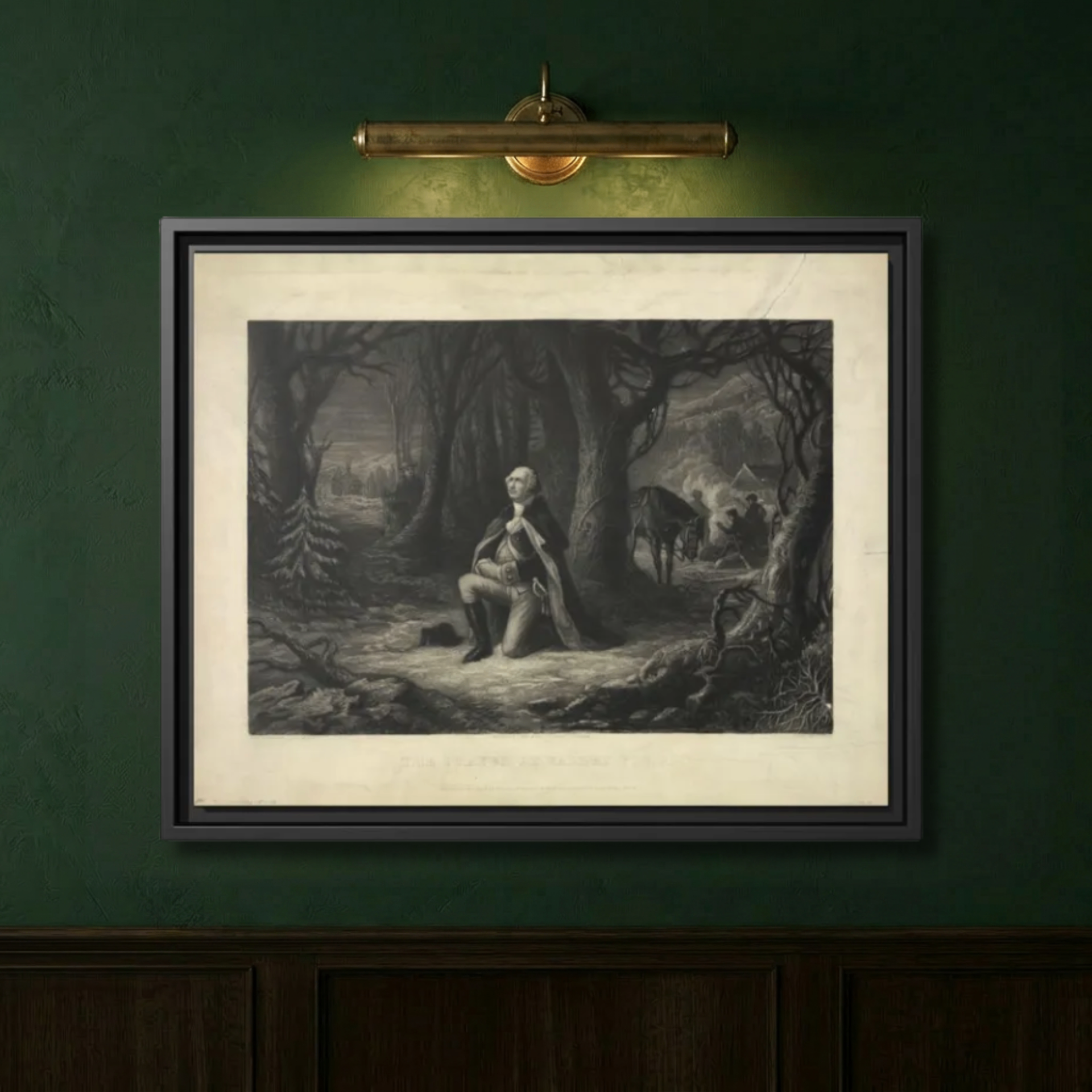
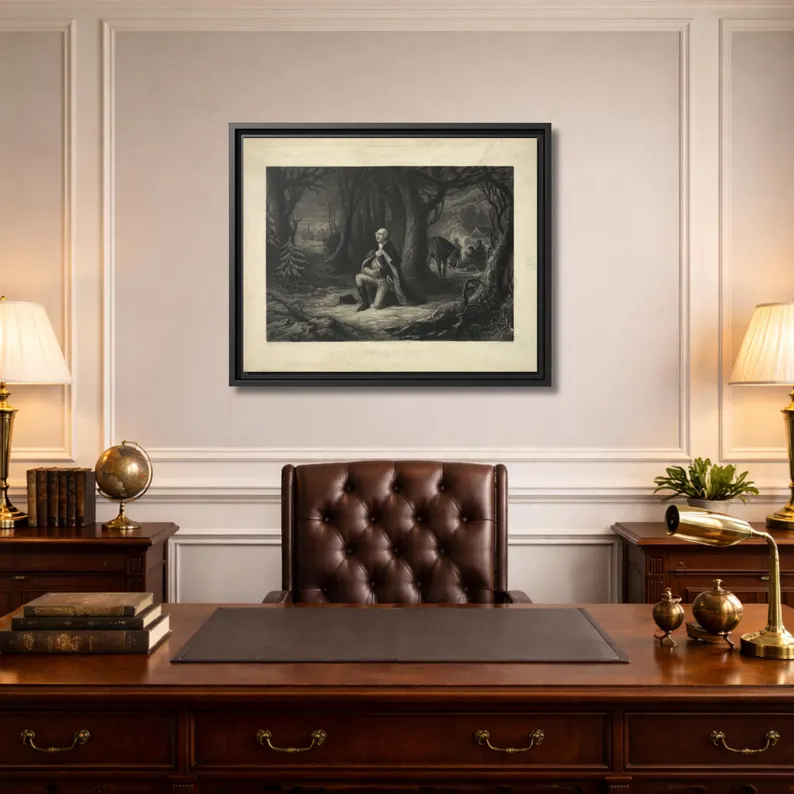
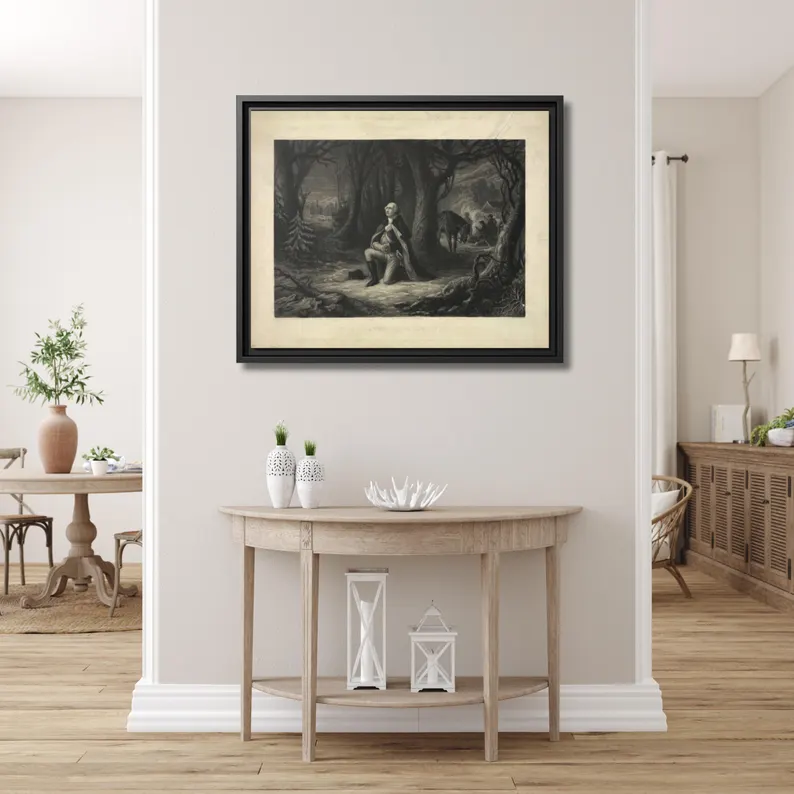

The Prayer at Valley Forge
After Henry Brueckner (American, 1836–1915); engraving by John C. McRae
c. 1866
The winter of 1777. The army was starving, freezing, and dissolving around him. Two thousand men would not survive to spring. George Washington rode into the woods at Valley Forge, dismounted, knelt in the snow, and prayed. He was not performing for an audience. There was no one watching — or so he thought. What happened in those woods that winter became one of the most enduring images of the American founding. Not a battle. Not a speech. A man alone with God, asking for help he wasn't sure was coming.
Size
20″ x 16″ (Horizontal)
Color
Espresso
The Story
The Story Behind the Painting
The story of Washington's prayer at Valley Forge comes primarily from a single eyewitness account — and like many of the most powerful moments in American history, its precise details have been debated by historians ever since.
Isaac Potts, a Quaker farmer who owned the property Washington used as his headquarters at Valley Forge, reportedly told his pastor years after the war that he had come upon Washington unexpectedly in the woods one day that winter. What he found stopped him cold. Washington was alone, on his knees in the snow, his horse tied nearby, his hat off, his hands clasped, praying aloud with an intensity Potts said he had never witnessed in any man before or since.
Potts, a pacifist Quaker who had opposed the Revolution on religious grounds, was so moved by what he saw that he reportedly told his wife that evening he now believed the American cause would succeed — because any man who prayed like that, in circumstances like those, was a man God would not abandon.
The historical authenticity of the Potts account has been questioned by some scholars — it was recorded decades after the events and passed through several hands before appearing in print. What is not questioned is the desperate reality of Valley Forge itself, or Washington's deep and private religious faith, documented throughout his life in letters, diaries, and the testimony of those who knew him.
Whether the specific prayer in the woods happened exactly as Potts described, something essential about the image is historically true. Washington was a man who bore the weight of the Revolution alone in ways his officers could only partially understand. The responsibility for 12,000 men surviving a winter that was trying to kill them — and for the cause of independence surviving a war that seemed designed to destroy it — rested on his shoulders in a way it rested on no one else's. That he sought something beyond himself in carrying that weight is entirely consistent with everything else known about his character.
Henry Brueckner painted this scene in the 1860s, nearly ninety years after the events depicted, as part of a broader cultural effort to establish Washington's spiritual character alongside his military and political legacy. John C. McRae's engraving of the painting became one of the most widely reproduced images of Washington in the second half of the 19th century — distributed across the country as a symbol of the faith that had sustained the founding generation through its darkest hours.
The image has never lost its power. The man in the woods, alone on his knees, asking for something no army could provide — that image reaches something in the American character that no battle scene or formal portrait has ever quite matched.
Why Own It
Every other image of Washington shows what he did. This one shows what sustained him.
The Prayer at Valley Forge belongs in the American Legacy Collection as its most intimate piece — the moment behind the moments, the private faith beneath the public resolve. Washington crossing the Delaware required courage. Washington at Valley Forge required something more — the willingness to keep going when the rational calculation said stopping was the only reasonable option. This painting asks what gave him that willingness. It offers one answer.
This is a piece for the home that understands that the greatest acts of leadership are sustained by something invisible to history — the private moments of doubt, faith, and recommitment that never make it into the official record. The study where the full human complexity of the founding generation is honored, not just the triumphant surface of it. The person of faith who wants Washington's faith represented on their wall alongside his generalship.
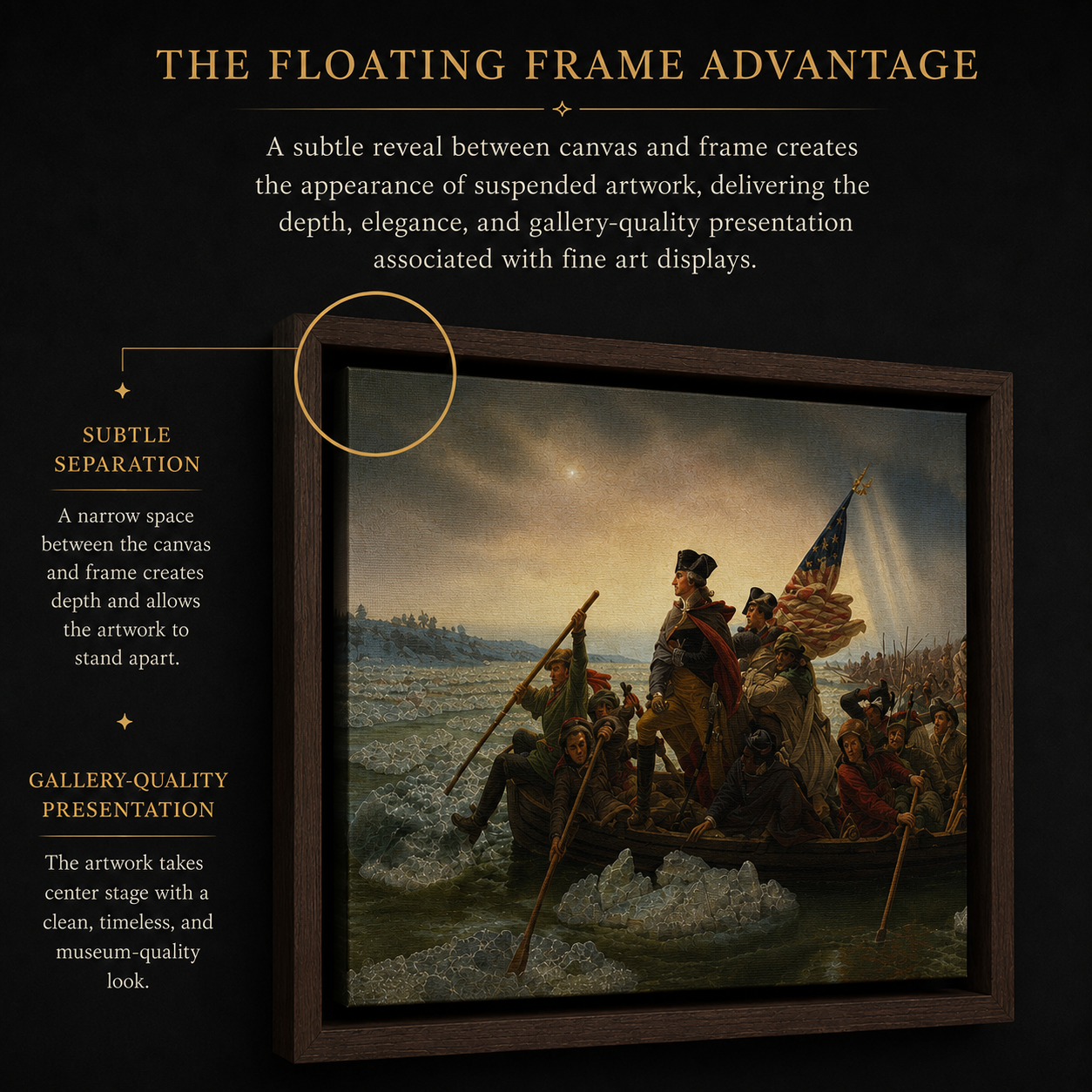
Printed on premium cotton-poly canvas with archival-quality, Greenguard Gold certified inks, it is built to the same standard of permanence the subject deserves — color that endures, detail that holds, a frame crafted from sustainably sourced FSC-certified pine that will outlast the trends.
Part of the American Legacy Collection — a curated series tracing the arc of the American story from the colonial era through World War II. Own one chapter or collect them all.
Crafted for collectors. Built to be passed down.
Frequently Asked