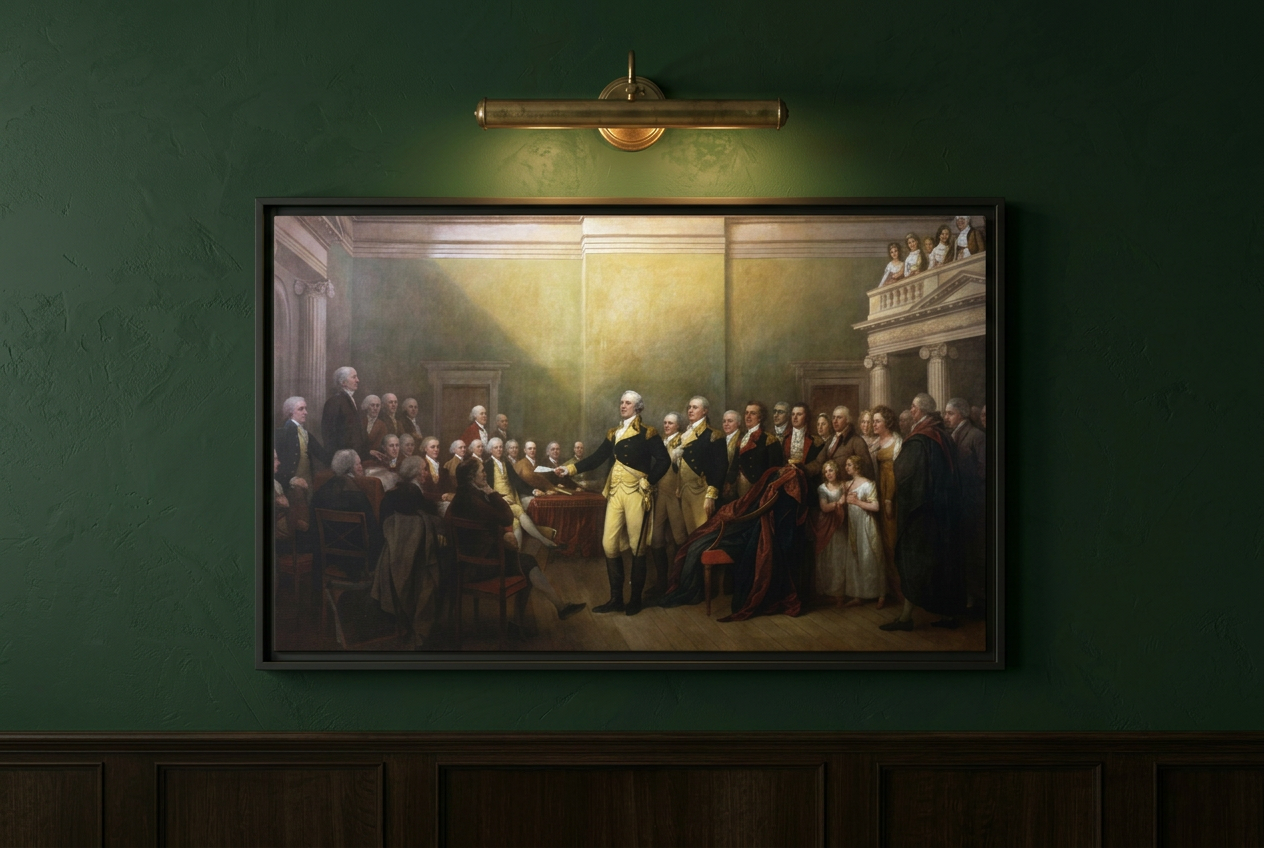
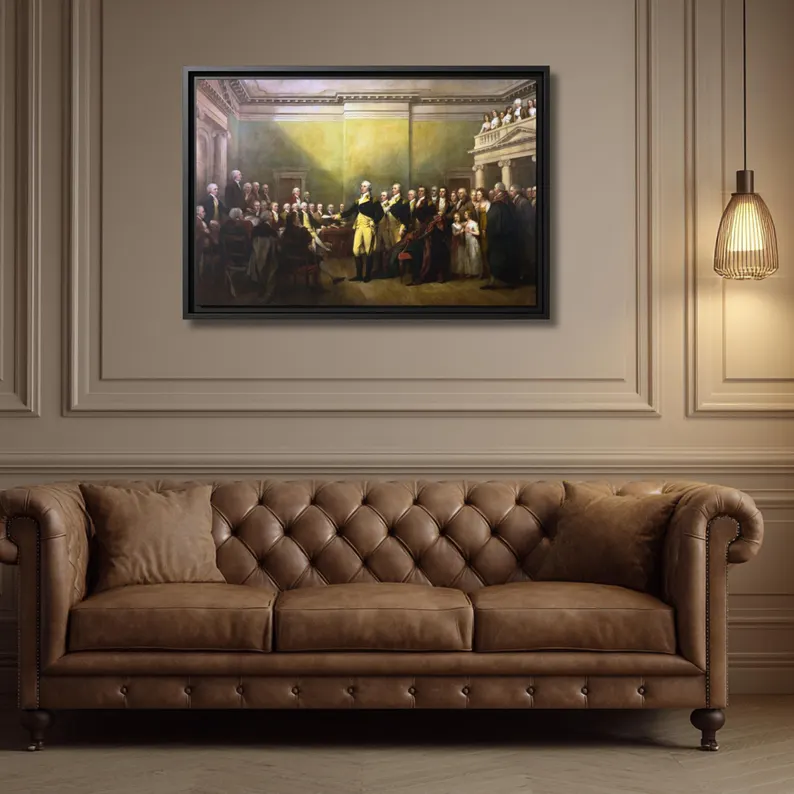
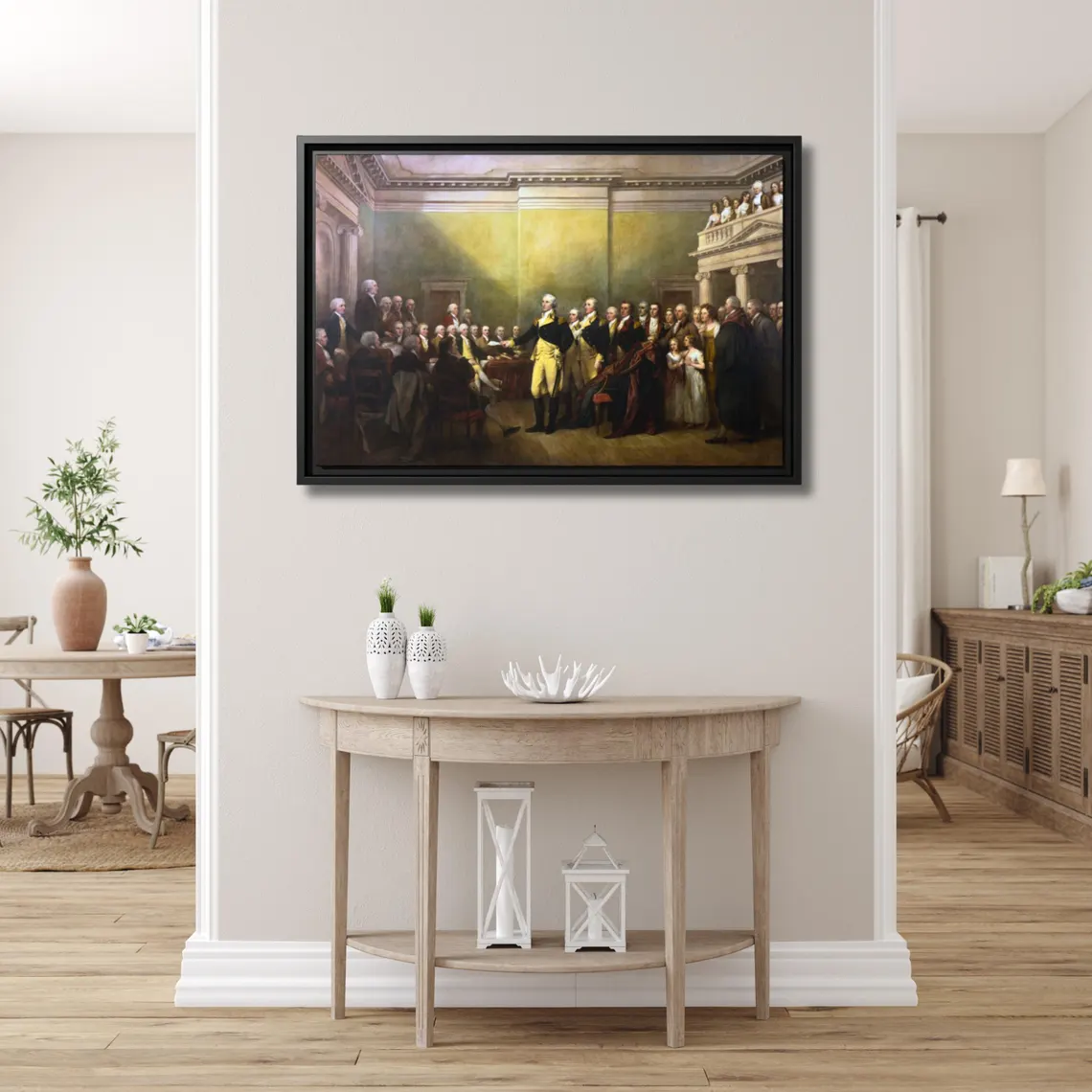
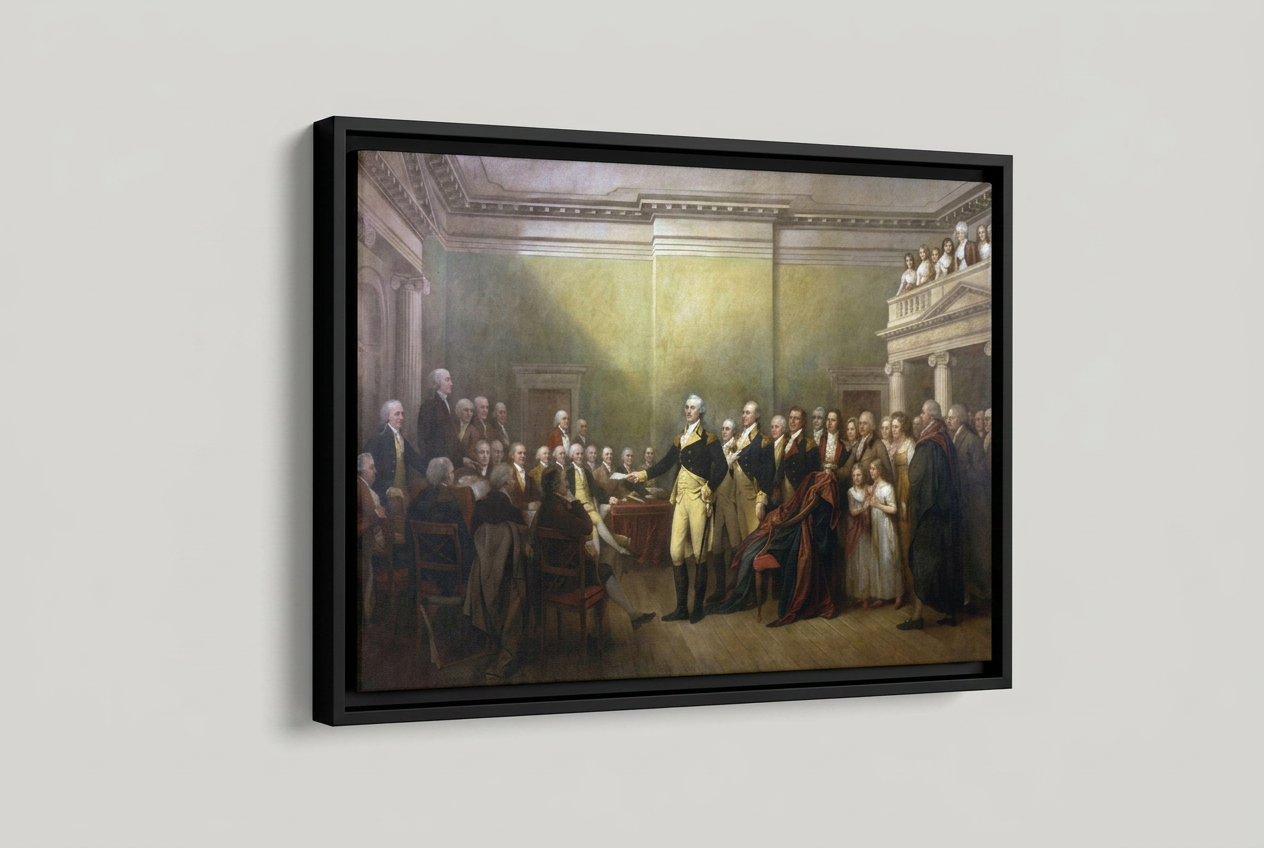

General George Washington Resigning His Commission
John Trumbull (American, 1756–1843)
1824
On December 23, 1783, George Washington walked into the Maryland State House in Annapolis and did something no victorious general had ever done in the history of the world. He gave the power back. He had commanded the most successful revolution of the modern era, led an army that had defeated the British Empire, and could have seized control of the new nation by force if he had chosen to. He chose to hand Congress a piece of paper instead. King George III called it the greatest act in human history. He was not wrong.
Size
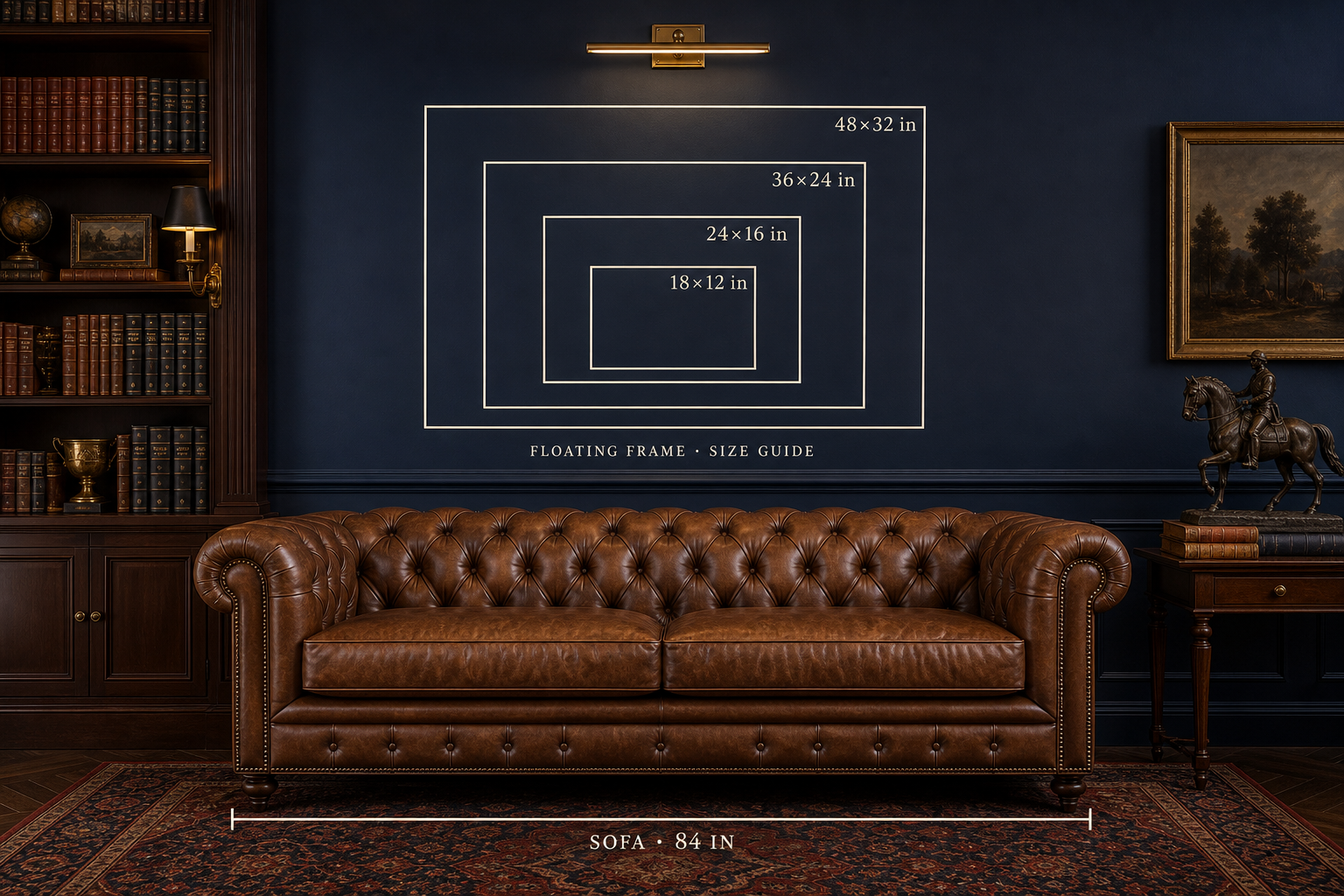
24″ x 16″ (Horizontal)
Color
Espresso
The Story
The Story Behind the Painting
In December 1783, the eyes of the world were on Annapolis.
Everyone who understood history understood what was about to happen — and understood that it had never happened before. Julius Caesar had crossed the Rubicon. Oliver Cromwell had dissolved Parliament. Napoleon would soon crown himself Emperor. The pattern of revolutionary leaders seizing permanent power was so consistent across history that it had come to seem almost inevitable — the natural endpoint of military triumph.
Washington was about to break the pattern entirely.
After saying farewell to his officers at Fraunces Tavern on December 4th, Washington traveled to Annapolis, where the Continental Congress was meeting. On December 23, 1783, he entered the Maryland State House chamber before the assembled Congress and formally resigned his commission as Commander-in-Chief of the Continental Army.
The room was packed. Members of Congress, state officials, diplomats, and citizens filled every available space. Women watched from the gallery above. Washington reportedly held the parchment commission in hands that trembled — not from weakness, but from the weight of the moment. He had to hold the document with both hands to keep it steady.
He spoke briefly. He thanked Congress, thanked his officers, acknowledged the role of Providence in the Revolution's outcome, and commended the interests of the country to the protection of Almighty God. Then he handed over his commission.
The room wept. Members of Congress wept. Washington wept. James McHenry, a delegate who was present, wrote to his fiancée that evening that the scene was too affecting to describe — that there was not a dry eye in the house.
Washington then walked out of the chamber, mounted his horse, and rode home to Mount Vernon — arriving on Christmas Eve, the day before Christmas, for the first time in eight years.
When King George III of England heard what Washington had done, he reportedly told the American painter Benjamin West that if Washington truly returned to his farm after winning the war, he would be the greatest man who had ever lived.
Washington returned to his farm.
John Trumbull painted this scene in 1824 as one of four large-scale historical paintings commissioned for the Rotunda of the United States Capitol — the same cycle that includes the Declaration of Independence, the Surrender of Cornwallis, and the Surrender of Burgoyne. It has hung in the Capitol Rotunda ever since, facing the Declaration of Independence across the most important room in American government — the beginning and the ending of the Revolution, watching each other across two and a half centuries.
Why Own It
Every revolution produces a victor. Almost none produce what Washington produced next.
General George Washington Resigning His Commission belongs in the American Legacy Collection as its moral culmination — the moment that completed the promise of the Declaration of Independence by proving it could actually work. The Declaration said governments derive their just powers from the consent of the governed. Washington's resignation proved it — demonstrated, in front of witnesses, that in America military power answered to civilian authority and not the other way around.
This is the act that made everything else possible. Without it, the Republic was theory. With it, the Republic became precedent — a model that has governed the relationship between military and civilian authority in America for 250 years.
This is a piece for the study that understands that the most important decision Washington ever made was not to attack at Trenton or stand firm at Valley Forge, but to walk into a room in Annapolis and hand over a piece of paper. The home that wants the founding generation's greatest act of principle displayed alongside its greatest acts of courage. The collector who understands that the Revolution was not complete until this moment — and that this moment was not inevitable until Washington made it so.
Printed on premium cotton-poly canvas with archival-quality, Greenguard Gold certified inks, it is built to the same standard of permanence the subject deserves — color that endures, detail that holds, a frame crafted from sustainably sourced FSC-certified pine that will outlast the trends.
Part of the American Legacy Collection — a curated series tracing the arc of the American story from the colonial era through World War II. Own one chapter or collect them all.
Crafted for collectors. Built to be passed down.
Frequently Asked