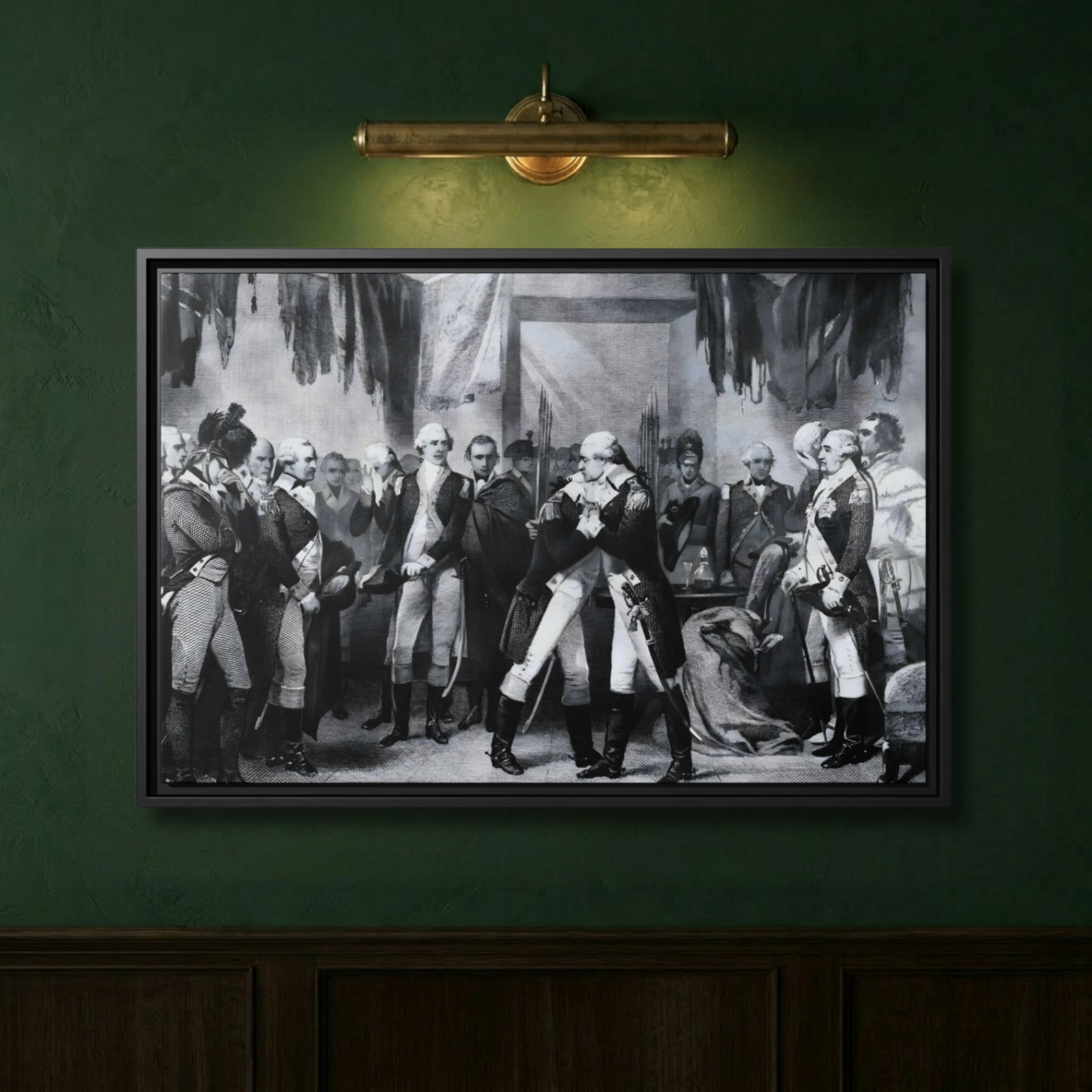
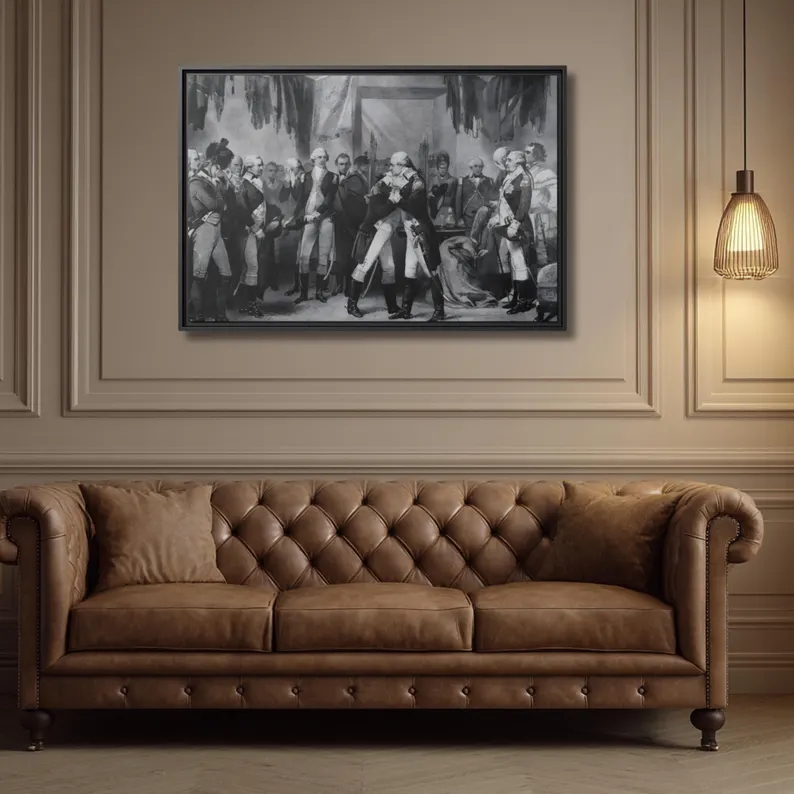
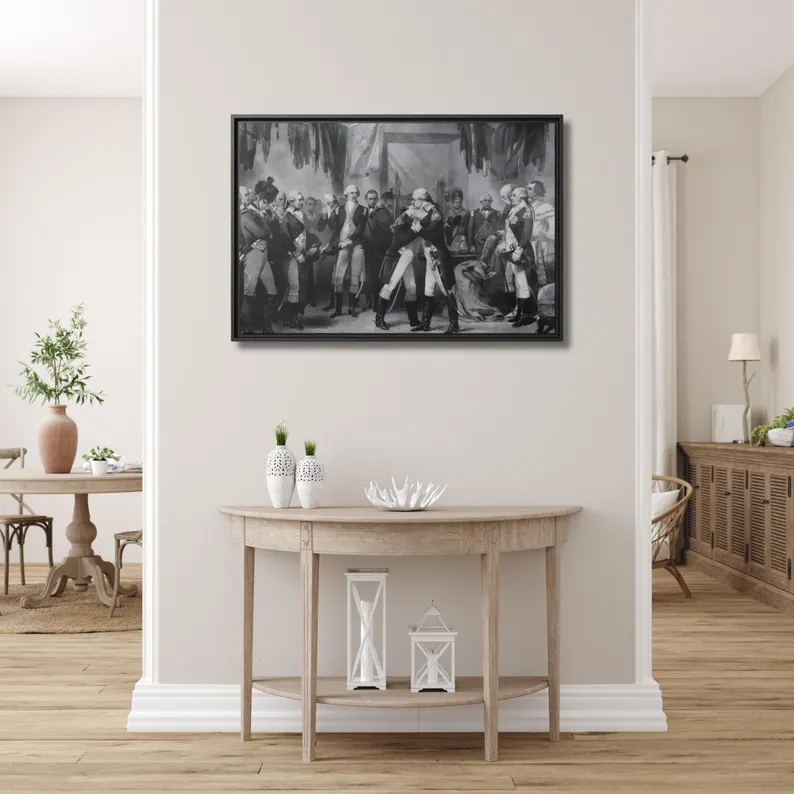
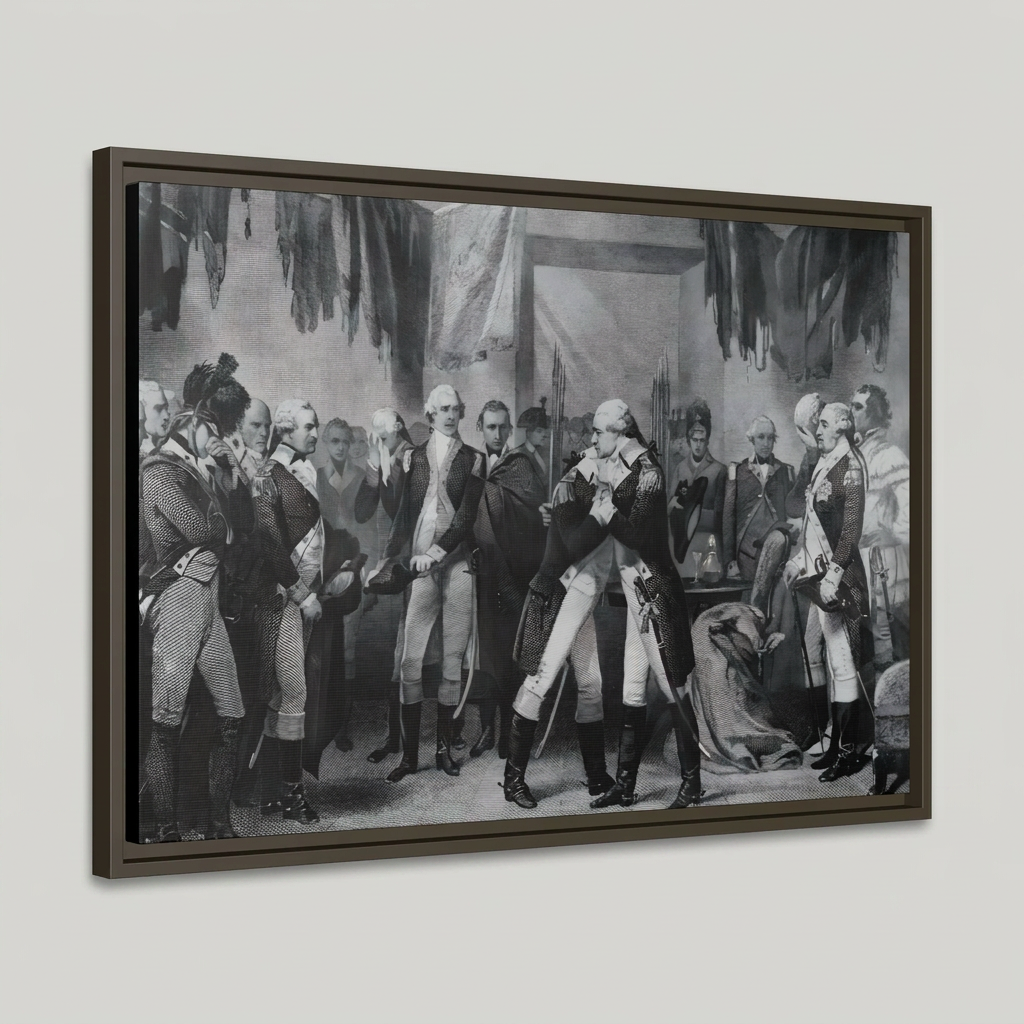

Washington's Farewell to His Officers
John Trumbull (American, 1756–1843)
1883
The war was over. The victory was complete. And George Washington stood in a tavern in New York and wept. On December 4, 1783, he called his officers together one final time at Fraunces Tavern, raised a glass, and said goodbye to the men who had fought beside him through eight years of impossible odds. Henry Knox, the man who had hauled cannons through winter mountains to save Boston, was the first to embrace him. Washington could not speak. Neither could anyone else in the room.
Size
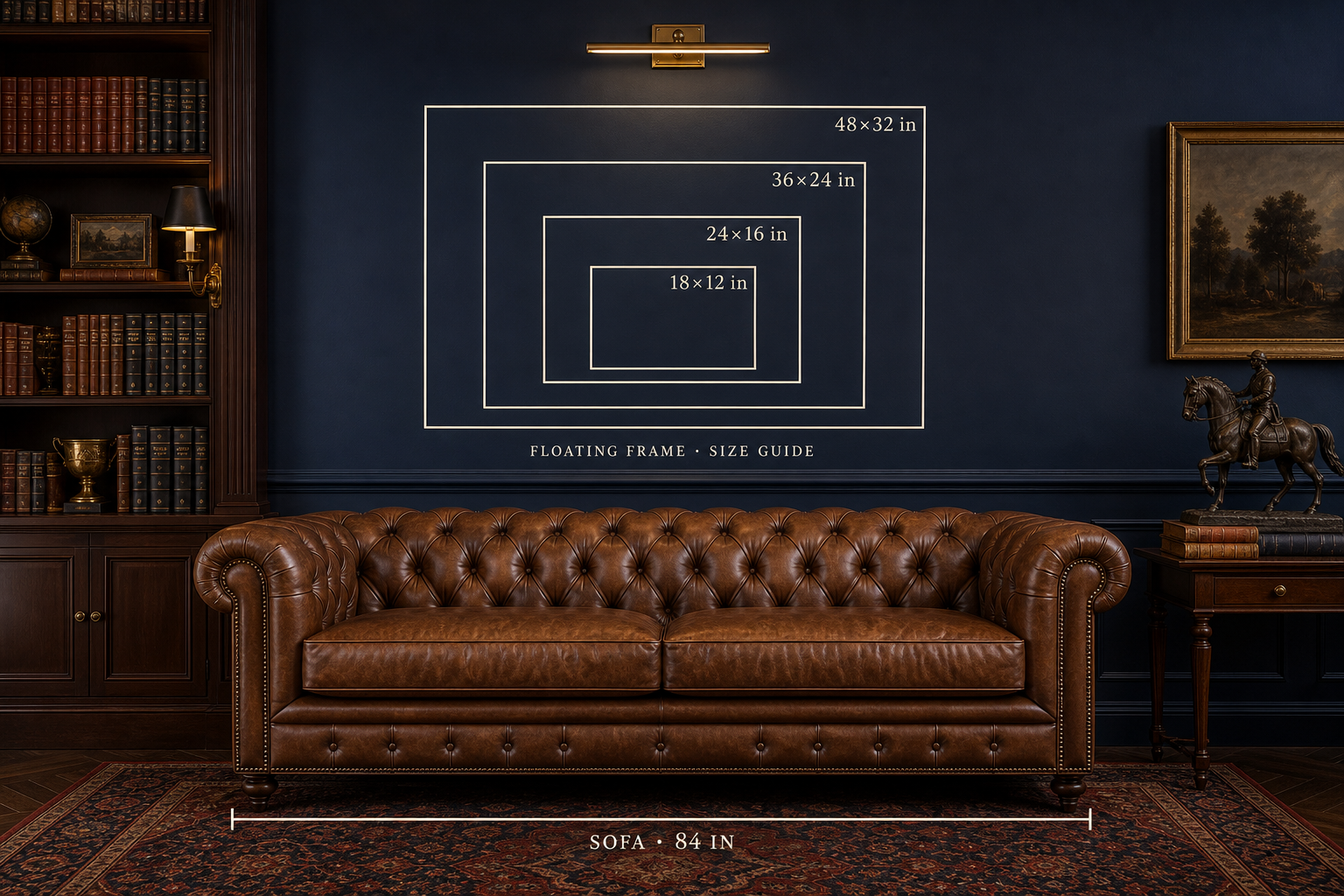
18″ x 12″ (Horizontal)
Color
Black
The Story
The Story Behind the Painting
By December 1783, it was finished.
The Treaty of Paris had been signed in September, formally ending the Revolutionary War and recognizing American independence. The last British troops had evacuated New York City on November 25th — Evacuation Day, celebrated in New York for over a century afterward. The eight-year war that had begun on a village green in Lexington with eight men dead in the grass had ended with a new nation intact and a former colony transformed into a republic.
Washington had one thing left to do before he could go home.
On December 4, 1783, he invited his surviving officers to join him at Fraunces Tavern on Pearl Street in lower Manhattan for a farewell. The men who came had shared everything with him — the desperate winter at Valley Forge, the improbable crossing of the Delaware, the long campaigns through New York and New Jersey and Virginia that had finally brought them to Yorktown and the surrender of Cornwallis. They had followed him when following him required everything.
Washington entered the room, poured a glass of wine, and tried to speak.
By most accounts, he could not manage it. His voice broke. He asked his officers to come forward individually so he could take their hands. Henry Knox, his chief of artillery — the young Boston bookseller who had somehow transported sixty tons of cannons from Fort Ticonderoga through the Berkshire Mountains in the dead of winter to save the siege of Boston — stepped forward first. Washington embraced him. Both men wept openly.
One by one the officers came forward. Washington embraced each one. No words were adequate to what was being said in that room, and Washington, who understood this, did not try to find them.
He left the tavern, walked through a crowd of silent citizens who had gathered outside, boarded a boat to New Jersey, and began the journey to Annapolis, where Congress was meeting. On December 23, 1783, before the assembled Congress of the United States, he formally resigned his commission as Commander-in-Chief of the Continental Army — returning to the civilian authority the military power that had been entrusted to him eight years earlier.
He then went home to Mount Vernon.
John Trumbull painted this farewell scene in 1883 — one hundred years after the event — as part of his lifelong project of documenting the defining moments of the Revolution. He had been there for much of it himself, having served briefly as an aide-de-camp to Washington. He understood what was in that room at Fraunces Tavern because he had known the men in it.
Fraunces Tavern still stands on Pearl Street in lower Manhattan, now a museum and restaurant, the oldest surviving building in New York City.
Why Own It
The Revolution ended on a battlefield. It concluded in a tavern, with tears.
Washington's Farewell to His Officers belongs in the American Legacy Collection as the emotional resolution of everything that preceded it — the battles, the crossings, the speeches, the documents, the years of sacrifice that had brought these men to this room on this December morning. Washington crossed the Delaware to save the Revolution. He stood at Yorktown to end it. He stood at Fraunces Tavern to say goodbye to the people who had made both possible.
What Trumbull captured in this painting is not victory — victory had already been secured. What he captured is the human cost of it, and the particular grief of men who had survived something together that most people never experience and can never fully explain to those who weren't there.
Rendered in black and white, the piece carries a gravitas that color reproductions of the same scene often lack — a deliberate aesthetic choice that places this farewell firmly in the historical record, where it belongs.
This is a piece for the study that understands that the greatest moments in history are followed by quiet rooms and hard goodbyes. The home that honors not just the triumph of the Revolution but the weight it left on the men who fought it. The collector who wants the complete arc — not just the crossing and the surrender, but the farewell that came after.
Printed on premium cotton-poly canvas with archival-quality, Greenguard Gold certified inks, it is built to the same standard of permanence the subject deserves — color that endures, detail that holds, a frame crafted from sustainably sourced FSC-certified pine that will outlast the trends.
Part of the American Legacy Collection — a curated series tracing the arc of the American story from the colonial era through World War II. Own one chapter or collect them all.
Crafted for collectors. Built to be passed down.
Frequently Asked